Do Auto Parts Stores Offer Free Car Battery Testing and Installation? The Quick Answer
The Short Answer: Yes, but with major caveats. Most national auto parts retail chains—such as AutoZone, Advance Auto Parts, O'Reilly Auto Parts, and NAPA—do offer complimentary battery testing and basic installation when you purchase a replacement battery from their store. However, while this free service sounds convenient, it is strictly limited to simple, accessible battery swap-outs. Retail store employees are typically not certified technicians, and their complimentary services stop short of handling complex vehicle architectures, modern electrical resets, or hard-to-reach battery compartments.
For owners of modern vehicles, particularly sophisticated engineering platforms like Mazda's i-Activsense and Skyactiv-G/X powertrains, swapping a battery is rarely a simple drop-in affair. Modern vehicles rely on integrated Battery Management Systems (BMS), smart alternators, and start-stop (i-Stop) features that require a dedicated digital diagnostic reset during installation. If you simply disconnect the old battery and bolt in a new one without recalibrating the vehicle's computer system, your vehicle may fail to charge the new battery correctly, disable engine start-stop functions, or throw error codes across your dashboard.
Before relying on a quick retail store swap in Plainfield or Joliet, it is crucial to understand what store clerks can safely perform—and when factory-certified service at Schedule Your Service Today with Hawk Mazda is necessary to protect your car's complex electrical architecture.
Free Auto Parts Store Battery Services: What Is Covered and What Isn't
What Is Typically Covered
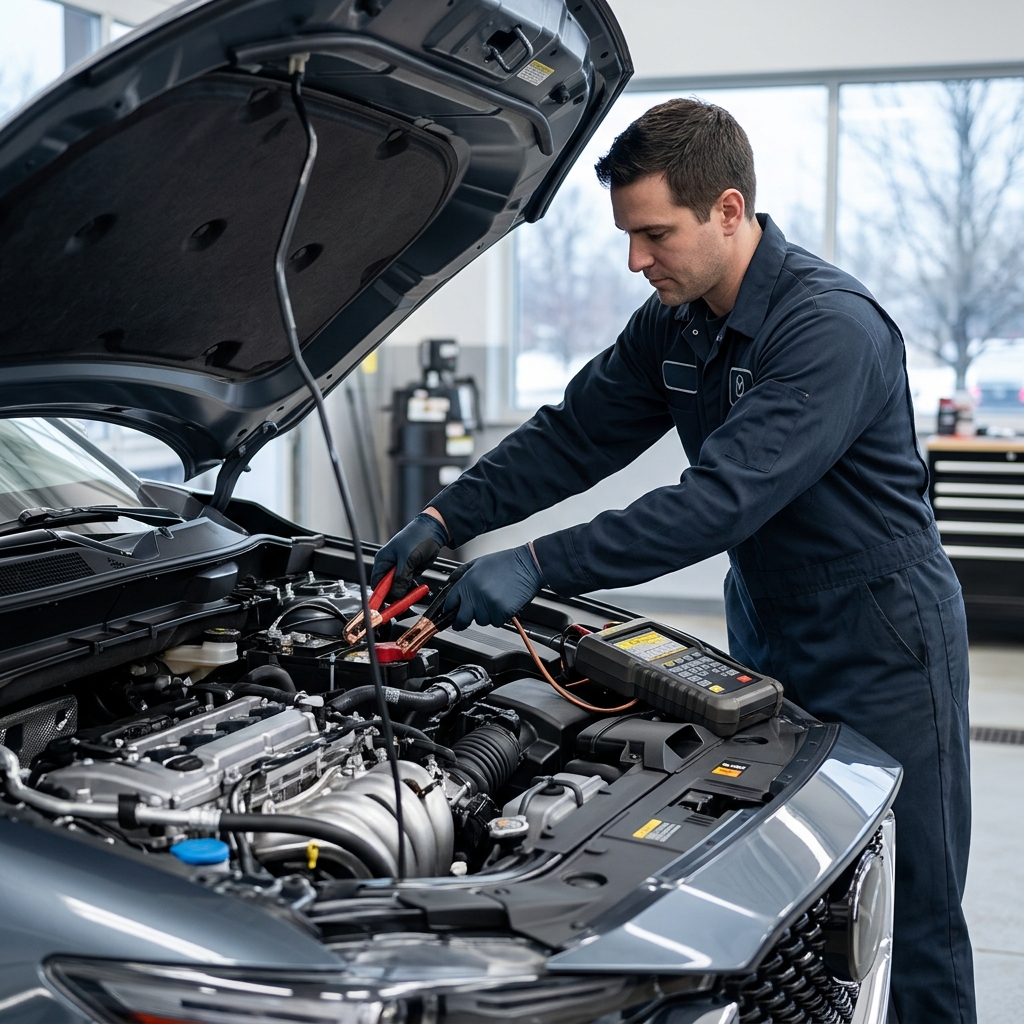
Retail auto parts locations provide hand-held battery testing that checks static voltage and basic cold cranking capacity. If you bring your battery into the store or drive up, a sales representative will connect a tester to determine if the battery holds a charge or has a dead cell.
If you purchase a replacement unit on site, they will generally install it for free, provided: • The battery is located directly under the hood in an unobstructed position. • The hold-down bracket and terminal clamps are standard hex bolts with no heavy corrosion. • No engine components, air intake boxes, or structural braces need to be removed. • The installation does not require electronic tool recalibration or software coding.
What Is Expressly Excluded
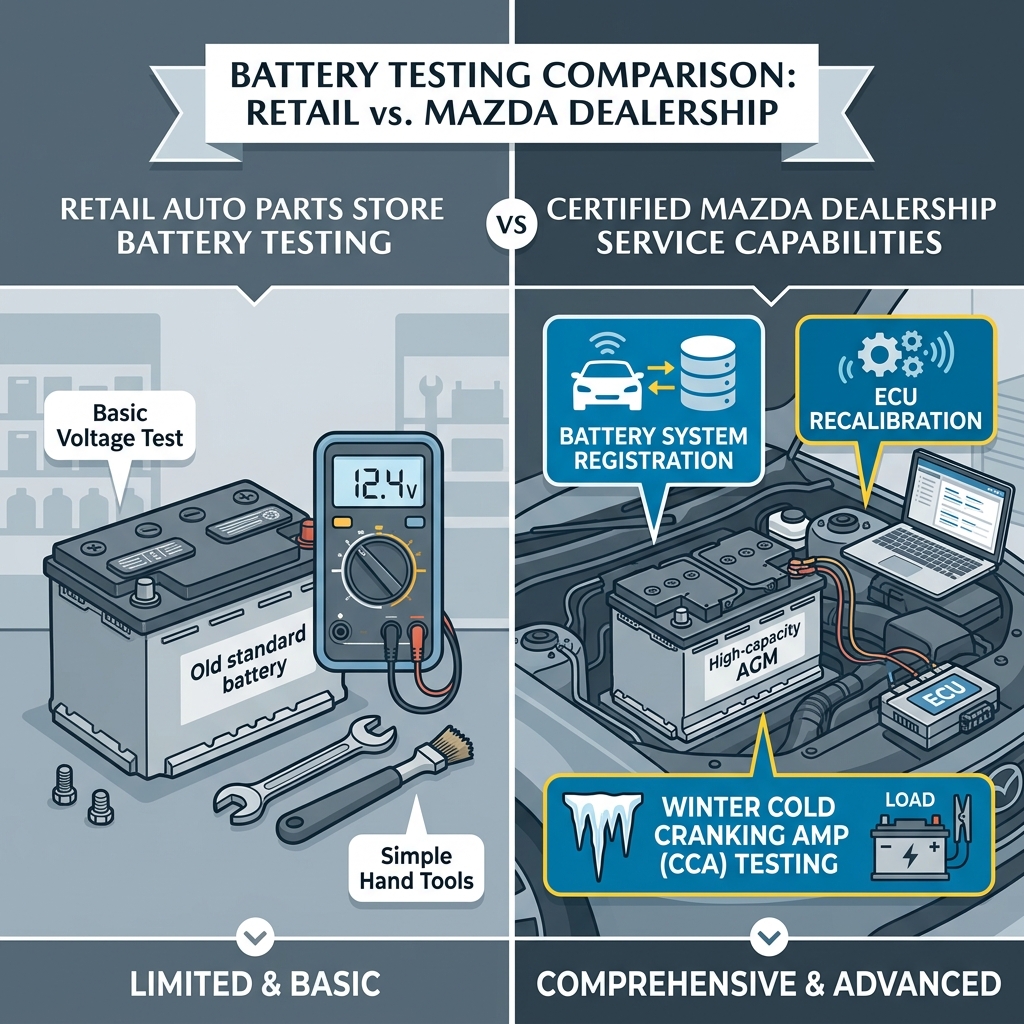
Due to corporate liability policies and time constraints, retail employees are restricted from performing labor-intensive installations. Exclusions include: • Hard-to-Access Locations: Batteries located under the rear seat, inside the trunk floor, or behind the front wheel well liner (common on many modern crossovers and SUVs). • Complex Disassembly: Vehicles requiring removal of the air intake plenum, fuse boxes, or computer modules to access the battery rack. • Corroded Hardware: Rusted terminal bolts or stripped cables that require cutting, thread restoration, or custom wiring terminal replacement. • System Coding & Diagnostic Resets: Resetting the Battery Management System (BMS) memory, clearing hidden fault codes, or restoring memory settings for power windows and steering position sensors.
Why Modern Mazda Battery Replacement Requires More Than a Quick Swap
Automotive engineering has evolved dramatically over the past decade. In current Mazda models like the CX-5, CX-30, CX-50, CX-90, and Mazda3, the battery is not merely an isolated power pack used to crank the starter motor—it is an active node within an interconnected electronic ecosystem.
1. Battery Management System (BMS) Calibration: Mazda vehicles track battery age, temperature, and degradation history to continuously regulate alternator charging voltage. When a new battery is installed, the engine control module (PCM) still assumes the old degraded battery is in place unless a manual software reset is triggered. Continuing to charge a brand-new AGM or flooded battery with old parameters will result in overcharging, overheating, and premature battery failure.
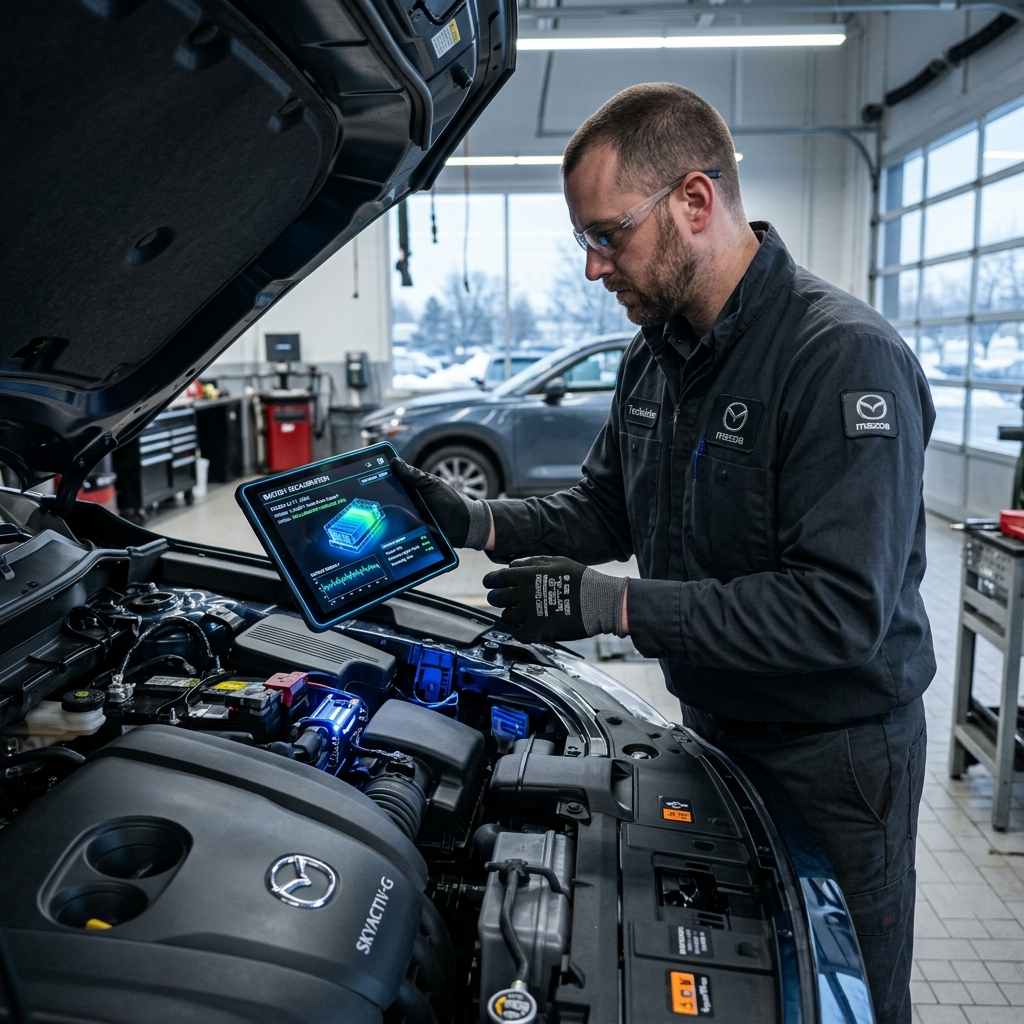
2. i-Stop & Smart Alternator Control: Mazda's intelligent stop-start technology depends on ultra-precise battery state-of-charge readings. If power is cut during a quick retail battery swap without auxiliary memory power, the system deactivates itself and logs a diagnostic trouble code (DTC). Certified technicians at Hawk Mazda utilize specialized factory diagnostic equipment (M-MDS) to register the new battery unit and recalibrate current sensors seamlessly.
Schedule Certified Mazda Battery Service in Plainfield, IL
Don't risk vehicle warning lights or shortened battery life with an incomplete store installation. Drivers in Plainfield, Shorewood, and Joliet can depend on Hawk Mazda for rapid diagnostic checks, factory OEM battery replacements, and complete electronic system re-initialization.
Are Car Batteries More Likely to Die in Winter or Summer?
Most drivers assume that cold winter frost is what kills automotive batteries. While it is true that dead batteries are overwhelmingly discovered on freezing winter mornings, summer heat is actually the true battery killer.
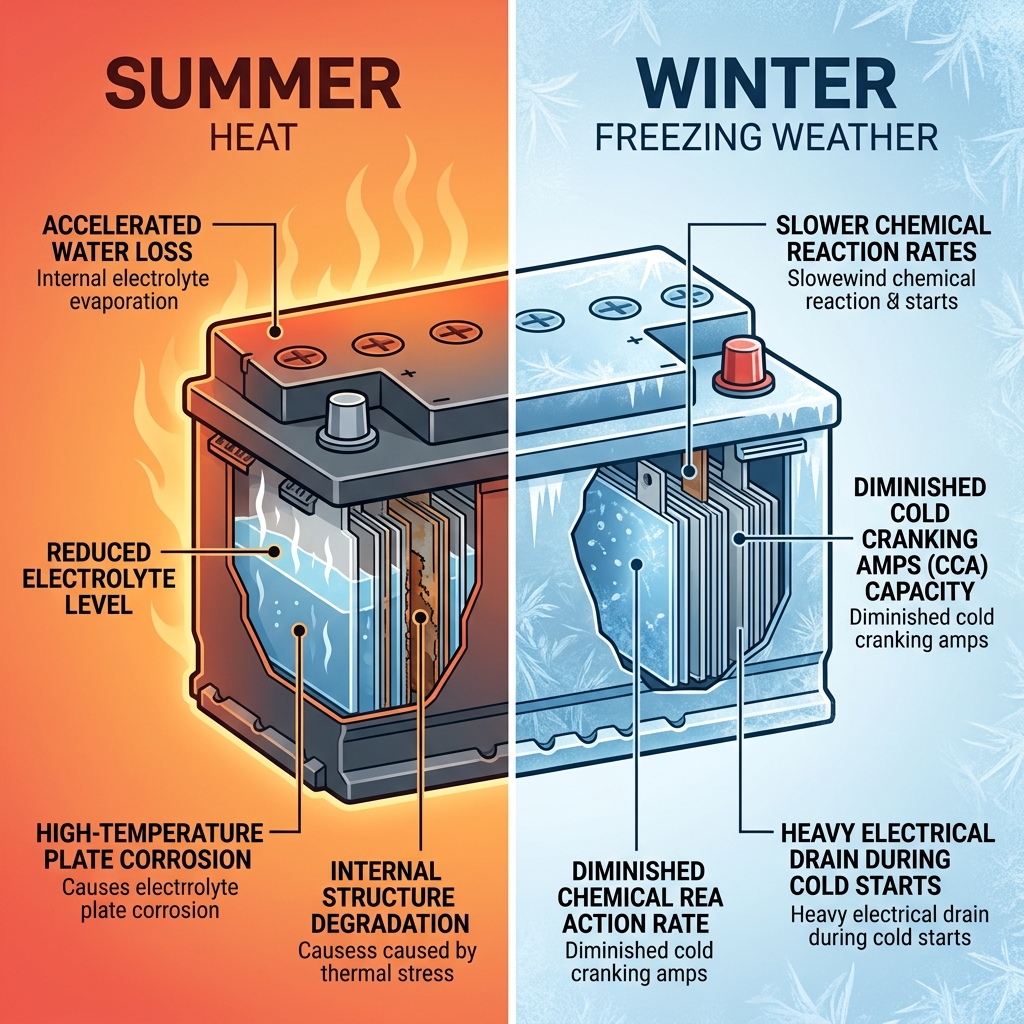
Summer Heat (The Unseen Damage): During hot Will County summers, under-hood temperatures routinely exceed 140°F. Heat accelerates chemical reactions inside lead-acid batteries, causing liquid electrolyte evaporation, plate grid corrosion, and internal self-discharge. Heat permanently damages internal components, drastically shortening total battery lifespan.
Winter Cold (The Reveal): When temperature drops below freezing during Illinois winters, the chemical reaction inside the battery slows down dramatically. At 32°F, a battery loses roughly 30% of its electrical strength; at 0°F, power drops by over 60%. A battery weakened by summer heat might survive moderate autumn temperatures, but the first sudden cold snapshot leaves it unable to crank the engine, resulting in a sudden no-start situation.
Why Does Cold Weather Kill or Drain Car Batteries in Northeastern Illinois?
1. Chemical Reaction Slowdown
Lead-acid batteries rely on a chemical reaction between lead plates and sulfuric acid solution to release electrons. Sub-zero Chicagoland temperatures stiffen the electrolyte solution, reducing ion mobility and sharply lowering peak current output.
2. Increased Engine Oil Drag
As outdoor temperatures plunge, engine oil thickens, increasing internal friction against pistons and crankshafts. Consequently, the starter motor requires up to two times more electrical current to turn over a cold engine than it does on a warm summer afternoon.
3. Heavy Electrical Accessory Loads
Winter driving demands maximum electrical draw from heated seats, heated steering wheels, cabin blowers, defrosters, wipers, and headlights. Short winter commutes don't allow the alternator sufficient drive time to fully replenish the depleted battery.
What Is Cold Cranking Amps (CCA) and Why Does It Matter for Joliet Drivers?
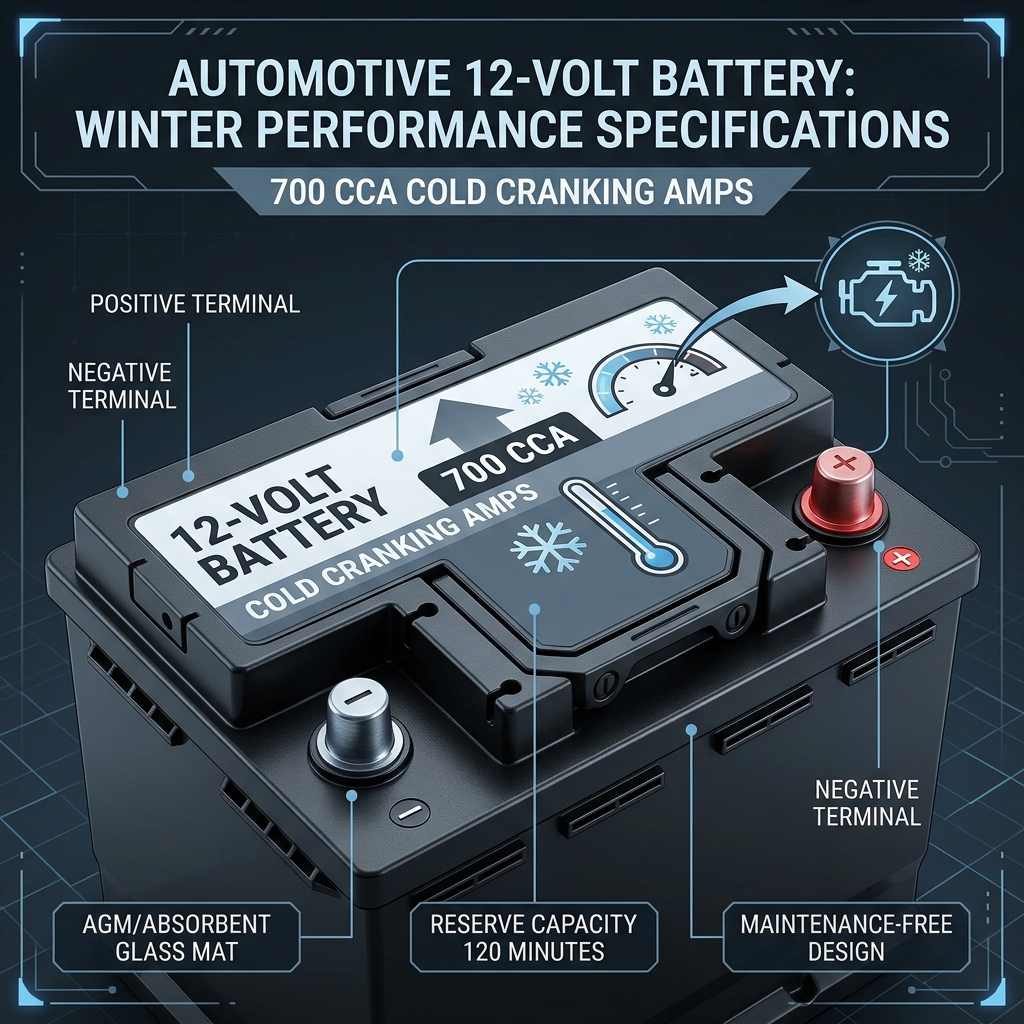
Cold Cranking Amps (CCA) is the industry standard rating that measures a battery's ability to start an engine in cold conditions. Specifically, CCA represents the number of amperes a 12-volt battery can deliver at 0°F (-17.8°C) for 30 seconds while maintaining a minimum terminal voltage of 7.2 volts.
Reading Battery Labels:• CCA (Cold Cranking Amps): Crucial for Northern Illinois weather. Higher numbers indicate stronger cold-start performance. • CA (Cranking Amps): Tested at 32°F (0°C). Do not confuse CA with CCA; CA ratings are easier to pass and can be misleading in freezing conditions. • RC (Reserve Capacity): The number of minutes a fully charged battery can run vital vehicle accessories if the alternator fails.
For Plainfield and Joliet commuters facing sub-zero winter commutes down I-55 or Route 59, installing a battery that meets or exceeds factory CCA specifications is vital. Selecting an under-powered replacement battery from a generic auto parts shelf will cause sluggish starting performance and potential winter strandings.
Get Your Car Battery Cold-Weather Tested at Hawk Mazda Today
Don't wait for the first freezing morning to discover your battery is failing. Our state-of-the-art diagnostic system evaluates CCA capability, state of charge, and internal resistance in minutes.
Should You Start Your Car and Let It Idle Every Day in Winter?
The Myth: Many drivers believe starting their car and letting it idle in the driveway for 15-20 minutes daily during cold weather recharges the battery and protects the engine.
The Reality: Long idling in cold weather actually does more harm than good to both your battery and your engine.
• Inadequate Alternator Output: At engine idle speed (approx. 600-800 RPM), modern alternators generate only minimal charging current. If you have the blower, defrosters, and seat warmers running simultaneously, the car is likely operating at a net electrical deficit, drawing energy out of the battery rather than charging it.
• Engine Oil Dilution & Fuel Waste: Cold engine idling causes incomplete fuel combustion, leading to unburned gasoline washing down cylinder walls into your motor oil, reducing lubrication efficiency.
The Best Practice: Start your vehicle, let it run for 30 to 60 seconds to establish oil pressure, and then drive smoothly. Modern Mazda vehicles recharge their batteries efficiently when driven at normal suburban speeds around Plainfield for 15 to 20 minutes.
AGM vs Flooded Lead-Acid Batteries: Which Is Better for Cold Winter Weather?
Standard Flooded Lead-Acid
• Technology: Liquid sulfuric acid electrolyte surrounding lead plates.
• Cold Performance: Adequate for standard vehicles without heavy electrical accessories.
• Pros: Lower upfront retail cost.
• Cons: Susceptible to vibration damage, faster self-discharge, shorter service life (3-4 years).
Absorbent Glass Mat (AGM)
• Technology: Glass fiber mat separators absorb electrolyte liquid entirely.
• Cold Performance: Outstanding cold cranking output and rapid charge acceptance.
• Pros: 2x to 3x longer lifespan, 100% spill-proof, handles stop-start tech.
• Cons: Higher initial cost, requires precise BMS coding.
The Verdict for Illinois Drivers
If your vehicle came factory-equipped with an AGM battery, you must replace it with an AGM battery. Down-grading to a standard flooded battery will overload the battery and lead to rapid failure within months. AGM is superior for harsh Illinois freeze cycles.
How to Tell When Your Car Battery Is About to Fail Before You Get Stranded
Recognizing early warning signs allows you to replace your battery on your terms rather than waiting for an unexpected failure on a cold morning. Keep an eye out for these 5 critical indicators:
1. Slow Engine Crank: When turning the key or pushing the start button, the engine cranks slowly or sluggishly ('r-r-r-r' sound) before starting.
2. Dimming Cabin Lights & Electronic Glitches: Headlights dim when idling at traffic lights, or cabin screens flickering during engine startup.
3. Battery Warning Light or i-Stop Warning: A illuminated battery symbol or disabled i-Stop indicator on your instrument cluster.
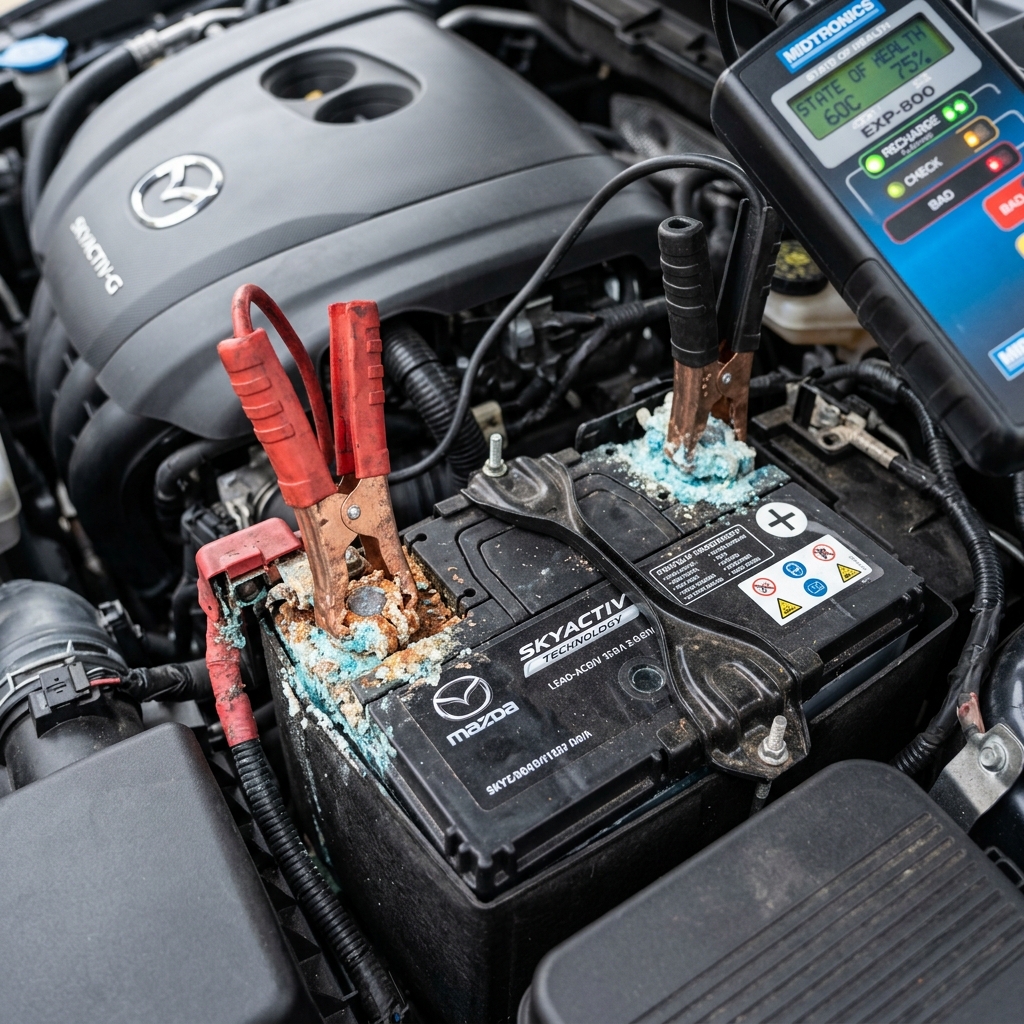
4. Case Bulging or Corrosion: Swollen battery casing caused by extreme heat buildup, or thick white/blue powder crusting around the battery terminals.
5. Age Over 3 to 5 Years: In Northern Illinois, most automotive batteries reach the end of their reliable lifespan between 36 and 60 months.
If you experience any of these signs, Call us at (779) 260-6502 to consult with our Hawk Mazda service advisors.
Order Genuine Mazda Batteries & Schedule Service Near Shorewood
Ensure absolute reliability with genuine Mazda OEM batteries designed specifically for your vehicle's engine management and electrical load specifications. Backed by competitive factory warranty coverage.
Auto Parts Store vs Dealership Battery Service: Making the Right Choice
|
Service Feature
|
Retail Auto Parts Store
|
Hawk Mazda Dealership Service
|
|
Basic Battery Health Check
|
Free hand-held test
|
Comprehensive digital system analysis
|
|
Installation Labor
|
Free (simple locations only)
|
Factory-certified expert installation
|
|
Hard-to-Reach Battery Locations
|
Declined / Unsupported
|
Fully supported with proper tools
|
|
Computer Reset / BMS Recalibration
|
No tools or software
|
Included with factory diagnostic tools
|
|
Alternator & Starter Testing
|
Basic voltage check
|
Full load & parasitic draw testing
|
|
Parts Quality
|
Generic aftermarket brands
|
Genuine Mazda OEM batteries
|
|
Warranty Coverage
|
Store limited replacement
|
Nationwide Mazda dealer warranty
|
While retail parts stores offer quick convenience for older or simple vehicles, certified dealership service at Hawk Mazda ensures your vehicle's modern electrical system, computer modules, and safety features remain fully protected and accurately calibrated.
Visit Hawk Mazda in Plainfield for Complete Battery Diagnostics and Service