At What Temperature Do All-Season Tires Lose Traction Compared to Winter Tires?

As autumn transitions into winter across Will County, drivers often wonder when their vehicle's tires begin to lose optimal grip. The exact temperature threshold is 45°F (7°C). Below 45°F, the rubber compound in standard all-season tires begins to harden, drastically reducing mechanical flexibility and surface adhesion on dry, wet, and frosty pavement alike.
While many drivers assume all-season tires are engineered for year-round freezing conditions, their rubber compounds are actually formulated to strike a balance between high summer temperatures and mild autumn chill. Once ambient temperatures hover consistently at or below 45°F, all-season tire treads stiffen into a rigid polymer state. In contrast, dedicated winter tires utilize specialized high-silica compound formulations that remain supple down to -22°F. This pliable contact patch allows winter tires to mold around subtle road imperfections, maintaining maximum surface grip when navigating cold morning commutes along I-55 or Route 59 in Plainfield. To inspect or upgrade your vehicle's rubber before the frost hits, you can easily Schedule Your Service Today with factory-trained technicians.
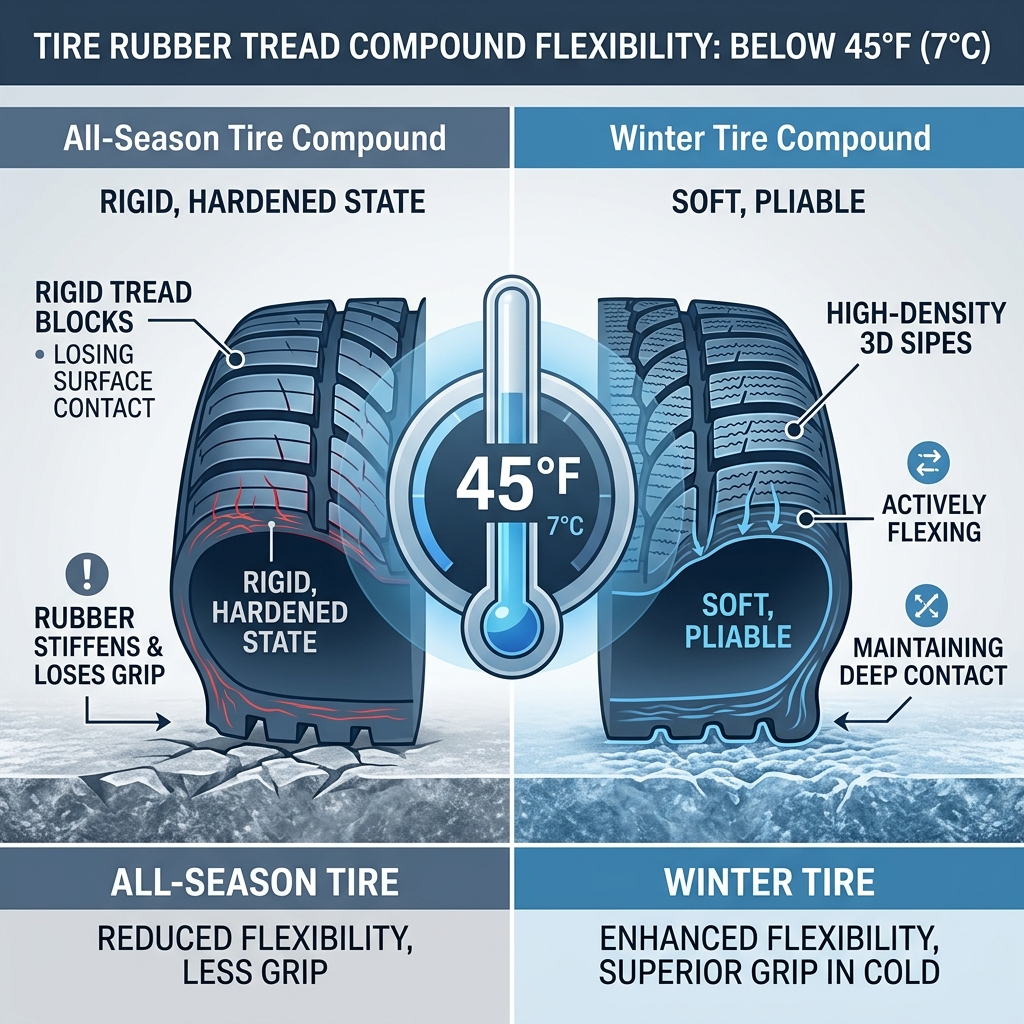
Diagram comparing all-season and winter tire flexibility and grip on cold roads below 45 degrees Fahrenheit. (Representative image for illustration purposes only. Actual vehicle may vary based on trim and configuration.)

Why 45°F Is the Critical Temperature Threshold for All-Season Tire Compounds
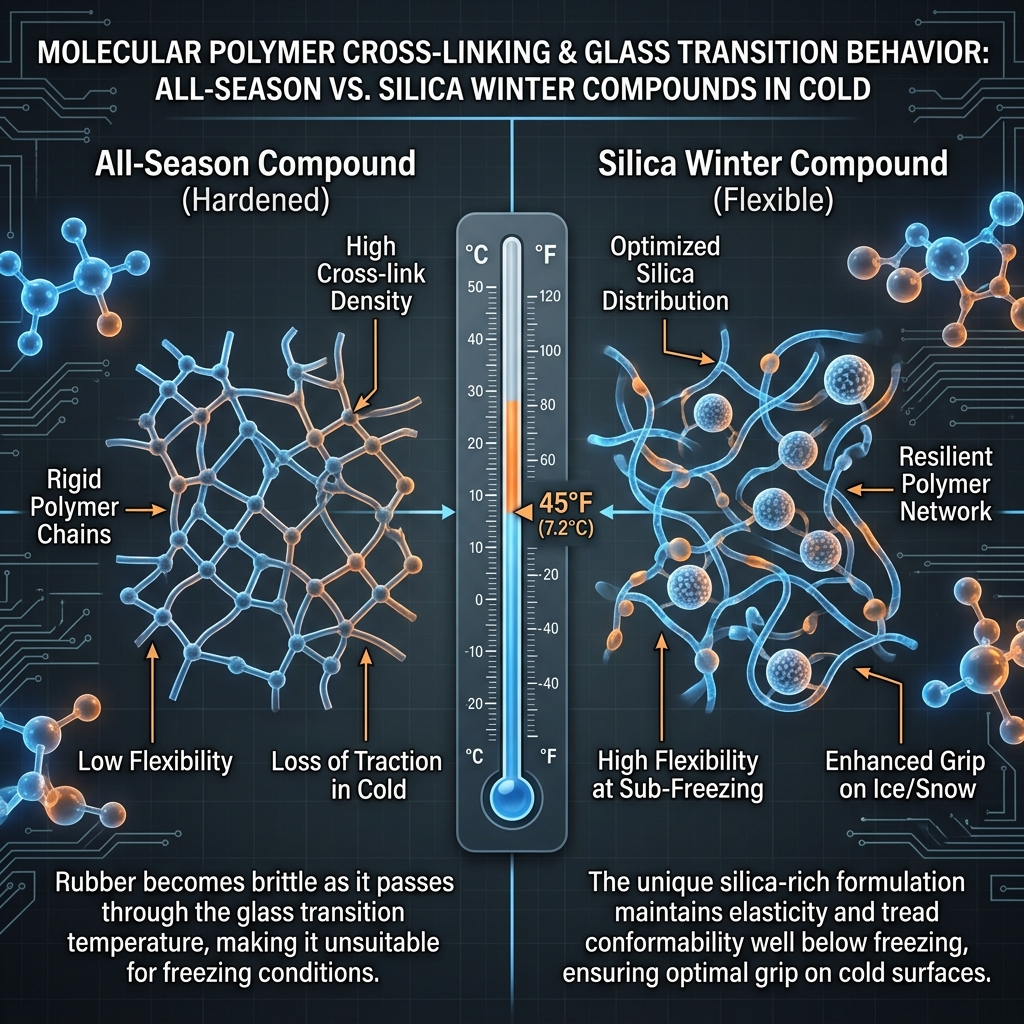
To understand why 45°F is the definitive line in the sand for tire traction, we must look at polymer chemistry. All tire treads are complex chemical matrices consisting of synthetic rubber, natural rubber, carbon black, silanes, and silica. In all-season tires, the vulcanized rubber formula is optimized to maintain stability when road surfaces reach upwards of 120°F in summer without melting or wearing down at extreme rates. However, this compromise means that as ambient temperatures drop toward the mid-40s, all-season compounds enter what materials scientists call the glass transition phase. During this transition, the once-elastic rubber polymers solidify and turn rigid. As a consequence, the tire can no longer micro-deform over asphalt irregularities, leading to a noticeable drop in mechanical grip even on completely dry pavement.
Diagram comparing molecular polymer cross-linking in all-season and silica winter tire compounds in cold weather. (Representative image for illustration purposes only. Actual vehicle may vary based on trim and configuration.)
Dedicated winter tires bypass this obstacle by incorporating advanced hydrophilic silica compounds combined with specialized functionalized polymers. Silica keeps the rubber matrix microscopic and flexible at temperatures well below freezing, ensuring that the tread conforms seamlessly to the road surface whether driving through Shorewood, Joliet, or downtown Plainfield.

Stopping Distance Comparison: All-Season vs. Winter Tires Below 45 Degrees

The loss of rubber flexibility translates directly into increased stopping distances during emergency braking maneuvers. Automotive engineering trials consistently demonstrate that even on clear, dry asphalt, cold temperatures cause all-season tires to slide farther before coming to a complete stop compared to winter tires.

Performance at 45°F

At the 45°F boundary, winter tires and premium all-season tires perform nearly identically on dry asphalt. However, on wet cold roads, winter tires begin demonstrating a 5% to 8% reduction in braking distance due to superior water-channelling sipes.

Performance at 30°F

As temperatures drop to 30°F, all-season rubber hardens significantly. On wet or frost-covered surfaces from 50 mph, winter tires can stop up to 18 to 22 feet shorter than standard all-season tires—a distance equivalent to more than one full car length.

Performance at 15°F

In sub-zero and deep freeze conditions (15°F and below), winter tires outperform all-season tires by up to 30 to 40 feet on packed snow and ice, offering critical accident avoidance safety on Northern Illinois highways.

Ambient Temperature

Surface Condition

All-Season Stopping Distance (50-0 mph)

Winter Tire Stopping Distance (50-0 mph)

Safety Margin Advantage

45°F (7°C)

Cold Dry Asphalt

115 feet

112 feet

+3 feet (2.6%)

35°F (2°C)

Cold Wet Rain

142 feet

126 feet

+16 feet (11.2%)

25°F (-4°C)

Frost / Light Snow

188 feet

154 feet

+34 feet (18.0%)

15°F (-9°C)

Hard-Packed Snow

212 feet

170 feet

+42 feet (19.8%)

Preparing Your Mazda i-Activ AWD for Early Autumn Rain and Frost in Will County
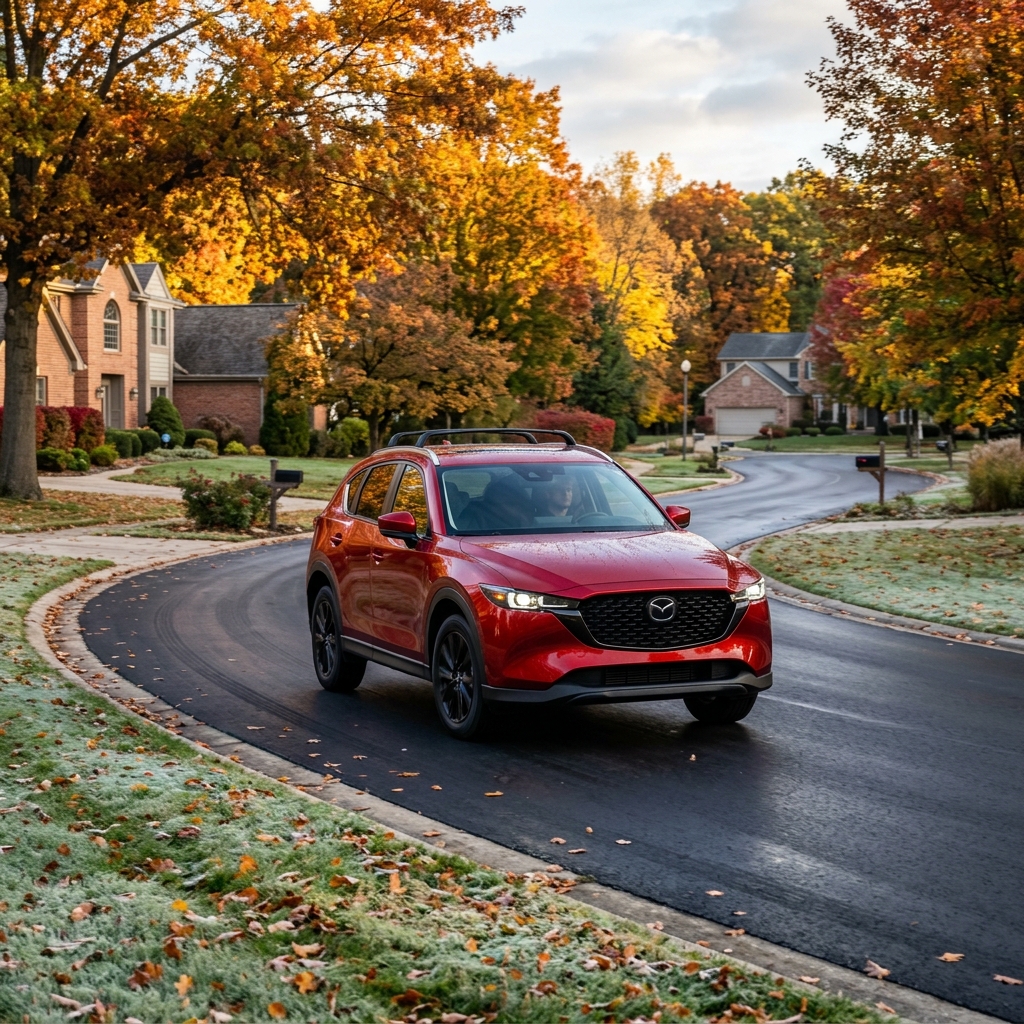
Autumn weather in Will County is notoriously unpredictable. Morning commutes along Route 59 or Lincoln Highway often begin with temperatures hovering in the mid-30s accompanied by damp mist or black frost, only to warm up to 55°F by late afternoon. This volatility creates stealth hazardous conditions where pavement looks merely wet but is actually covered in microscopic ice crystals. While advanced all-wheel drive systems like Mazda i-Activ AWD® deliver extraordinary torque distribution across all four wheels, AWD cannot create traction where mechanical rubber grip does not exist. The all-wheel drive system relies entirely on the friction generated at the contact patch of each tire. If all four tires have hardened due to sub-45°F temperatures, even the most sophisticated electronic control system cannot prevent sliding during sudden cornering or panic braking.
To get your crossover ready for early season frost, visit our local dealership. You can Get Directions to Hawk Mazda to speak with our service advisors in person.
Red Mazda CX-5 SUV driving along a winding suburban road lined with vibrant autumn trees and brick homes. (Representative image for illustration purposes only. Actual vehicle may vary based on trim and configuration.)

How Does Mazda i-Activ AWD Adjust to Early Autumn Rain and Slick Road Conditions?

Mazda's proprietary predictive i-Activ AWD® is engineered specifically to anticipate wheel slip before it happens. Unlike conventional all-wheel drive systems that react only after a tire begins to spin out of control, i-Activ AWD continuously monitors 27 different vehicle sensors at a rate of 200 checks per second.
These sensors measure ambient outdoor temperature, windshield wiper activity, steering angle, brake fluid pressure, engine torque output, and individual wheel rotational speed. When the outside temperature sensor registers drops below 45°F and the windshield wipers indicate rain, the system instantly calculates the reduced friction coefficient of the cold road surface. It proactively shifts driving torque to the rear wheels to prevent slipping when accelerating away from a stoplight on wet pavement. Pairing this intelligent predictive AWD technology with dedicated winter tires ensures unmatched stability through Northern Illinois winters. If you are shopping for a new crossover equipped with this technology, you can Browse New Mazda Inventory today.

Tread Pattern Differences: Sipes, Channels, and Snow Traction Engineering

Beyond rubber chemical compounds, tread design plays a vital role in cold weather performance. Winter tires feature physical architecture engineered to clear slush, pump away standing water, and bite into packed snow.
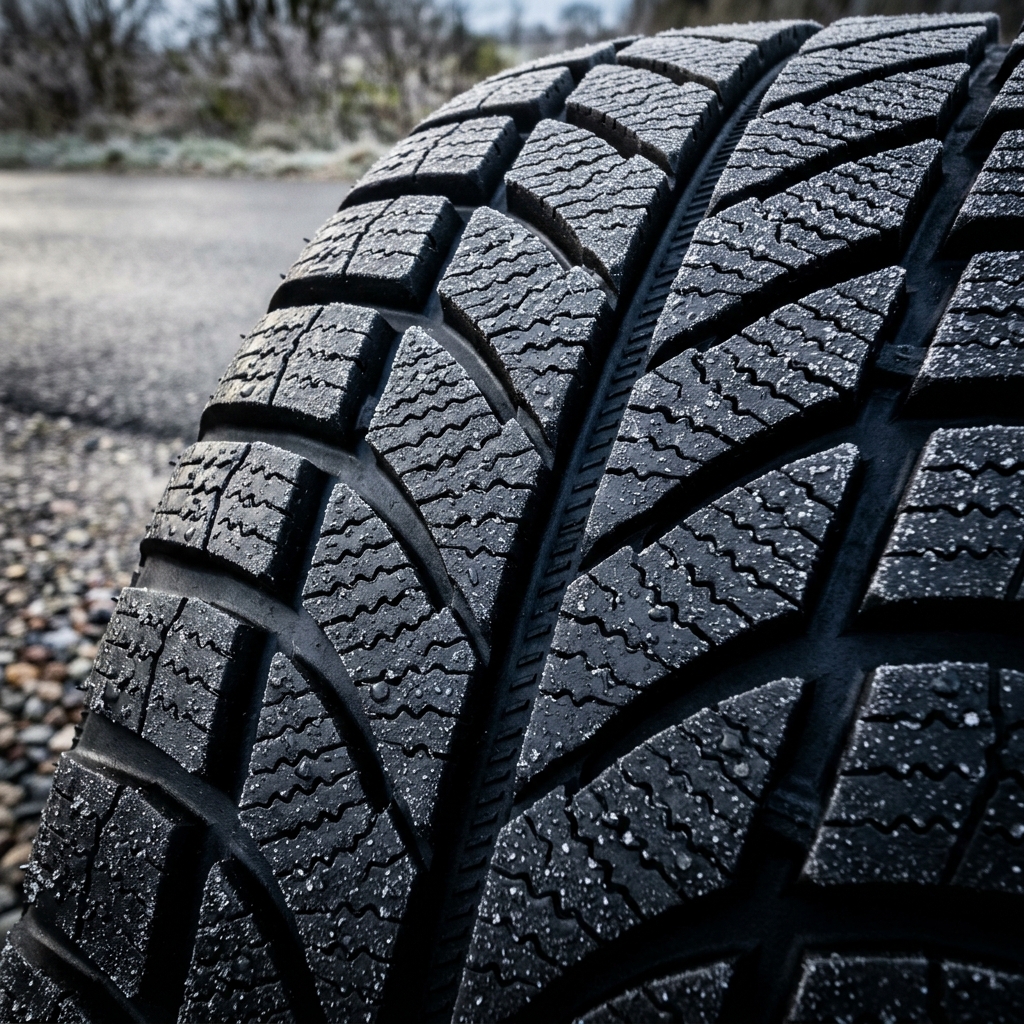
High-Density 3D Sipes

Winter tires feature thousands of microscopic zig-zag slits known as sipes. As the tire rotates, these sipes open up to bite into snow and ice while flexing to squeeze thin films of water away from the contact patch.

Slush Evacuation Channels

Deep circumferential and directional V-shaped grooves channel standing rain and heavy freezing slush outward away from under the tire, dramatically reducing hydroplaning risks during heavy autumn downpours.

Snow-on-Snow Grip

Snow actually adheres best to other snow. Winter tire tread block pockets are engineered to pack snow into their grooves, utilizing inter-cellular snow traction to grip winter road surfaces with surprising force.
Close-up view of a black winter car tire tread covered in frost droplets on a cold road. (Representative image for illustration purposes only. Actual vehicle may vary based on trim and configuration.)

How Much Do a Set of 4 Winter Tires Cost for a Mazda SUV?

Investing in dedicated winter tires is one of the most cost-effective safety enhancements you can make for your Mazda SUV. A set of four winter tires for popular crossovers like the Mazda CX-30, CX-5, CX-50, or CX-90 typically ranges between $650 and $1,300, depending on rim size and tread technology tier. While purchasing an additional set of tires requires an upfront investment, it does not actually double your long-term tire expenses. Running winter tires during cold months doubles the lifespan of your primary all-season or summer tires by taking them off the road for nearly half the year.
Furthermore, avoiding a single cold-weather fender bender saves hundreds or thousands of dollars in collision deductibles and insurance premium increases. Many auto insurance carriers also offer seasonal tire discounts when drivers install four 3-Peak Mountain Snowflake (3PMSF) rated winter tires. If you're interested in replacing existing tires or upgrading components, you can easily Order Genuine Mazda Parts through Hawk Mazda.

Mazda Model

Recommended Tire Size

Est. Set of 4 Cost (Tires Only)

Optional Winter Wheel Package

Mazda CX-30

215/65R16 / 215/55R18

$650 – $850

$1,150 – $1,450

Mazda CX-5

225/65R17 / 225/55R19

$720 – $980

$1,250 – $1,600

Mazda CX-50

225/65R17 / 245/45R20

$780 – $1,100

$1,350 – $1,800

Mazda CX-90

265/55R19 / 275/45R21

$950 – $1,350

$1,650 – $2,200

What Is Included in a Mazda Autumn or Pre-Winter Inspection Package?

Before winter frost sets in, comprehensive preventive maintenance is essential. At Hawk Mazda in Plainfield, our seasonal pre-winter inspection package thoroughly evaluates your vehicle's critical cold-weather safety systems.
Tire Tread & Pressure

We measure tread depth across outer, center, and inner channels to verify uniform wear. Cold tire pressures are adjusted to manufacturer spec, compensating for the 1 PSI drop experienced for every 10°F decrease in ambient air temperature.

Battery & Electrical

Freezing weather drains battery reserve capacity by up to 35%. Our technicians test Cold Cranking Amps (CCA), clean battery terminal corrosion, and evaluate charge retention to prevent unexpected vehicle non-start issues.

Brakes & Visibility

We inspect brake rotor surfaces and pad thickness for even wear. Wiper blades are evaluated for streaks or rubber cracking, and sub-zero washer fluid is refilled to keep windshields clear through winter storms.
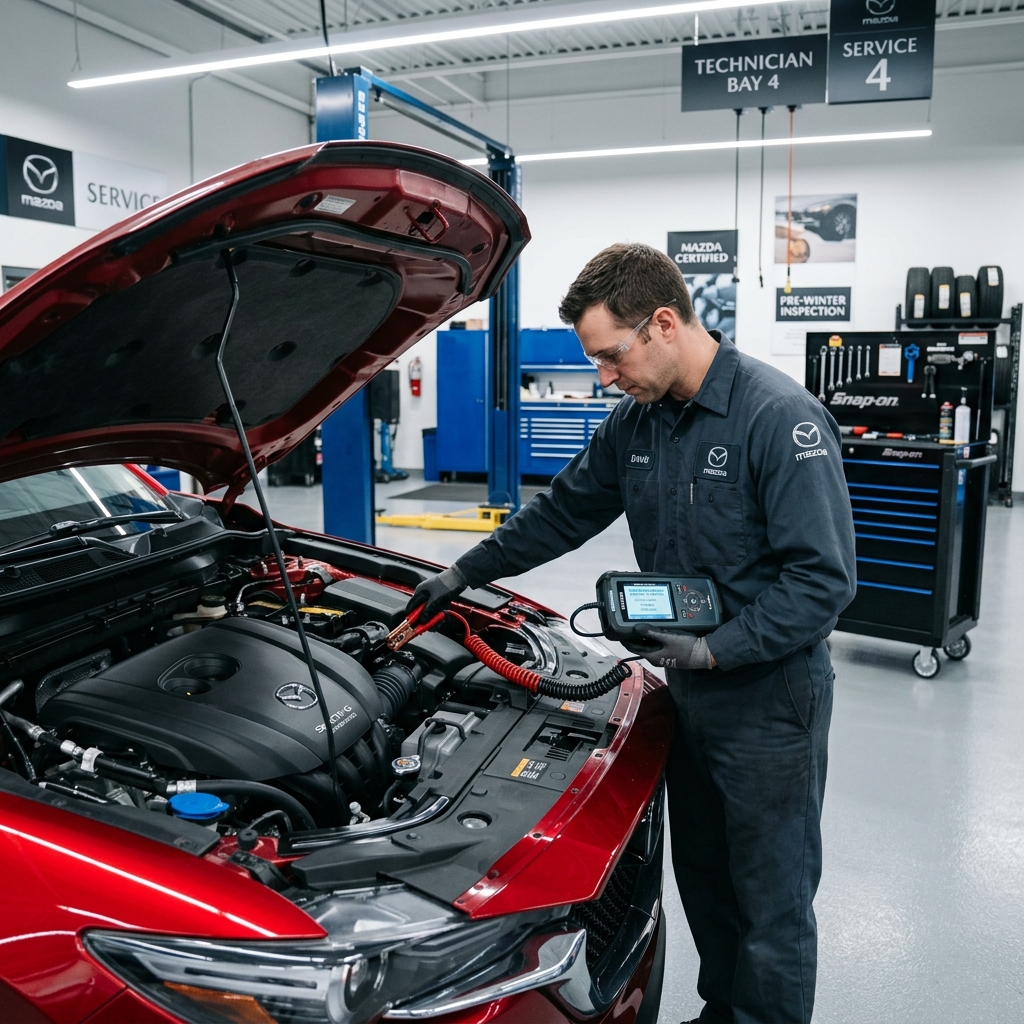
A Mazda service technician using a handheld diagnostic tool under the hood of a red car in a service bay. (Representative image for illustration purposes only. Actual vehicle may vary based on trim and configuration.)

How Should You Clean and Inspect Mazda i-Activsense Safety Sensors After Heavy Rain or Frost?

Modern Mazda vehicles are equipped with i-Activsense® advanced driver-assistance safety suites. These systems rely on sensitive optical and radar sensors positioned around the exterior of the vehicle. Rain, road grime, salt spray, and morning frost can coat these sensor lenses, temporarily disrupting critical safety functions like Smart Brake Support, Lane Keep Assist, and Adaptive Cruise Control.
To keep your safety systems working perfectly throughout autumn and winter, follow these simple maintenance steps: • Front Radar Emblem: Gently wipe the front Mazda emblem on your vehicle's grille using a soft microfiber cloth and warm water. Never use abrasive scrapers or harsh chemicals that could scratch the protective plastic housing covering the millimeter-wave radar. • Windshield Forward Sensing Camera: Turn on your front windshield defroster to melt ice accumulation in front of the camera module located behind the upper rearview mirror. Keep the glass clean of streaks using fresh wiper blades. • Ultrasonic Rear Sonar Sensors: Clear dirt and slush build-up from the small circular bumper sensors using mild soapy water to maintain accurate reverse parking guidance.

Can You Schedule Mazda Maintenance and Multi-Point Inspections Online?

Yes! Scheduling routine maintenance, tire rotations, or winter changeover service at Hawk Mazda is quick and convenient. Our online portal allows you to reserve service appointments from your smartphone or computer in under two minutes. Simply input your vehicle's year and model, select the specific services required (such as tire mounting, wheel alignment, or pre-winter inspection), choose your preferred factory-certified technician, and lock in a date and time that fits your busy schedule.
Tablet displaying a vehicle service app next to a cup of coffee on a wooden kitchen counter by a window. (Representative image for illustration purposes only. Actual vehicle may vary based on trim and configuration.)

All-Weather vs. Dedicated Winter Tires: Choosing the Right Option for Chicagoland Commuters

When upgrading for cold weather driving in Northern Illinois, drivers typically choose between two primary categories: All-Weather tires and Dedicated Winter tires. Understanding the difference between these options helps you select the ideal solution for your commuting routines.

All-Weather (3PMSF)

All-Weather tires earn the 3-Peak Mountain Snowflake emblem while remaining suitable for year-round driving. They offer flexible cold-temperature grip down to 15°F without requiring seasonal tire changeovers in spring.

Dedicated Winter Tires

Designed strictly for cold weather (below 45°F), dedicated winter tires offer maximum grip on thick ice and unplowed snow. They are ideal for daily highway commuters traveling along I-55 or I-80 during heavy winter storms.

Which Should You Choose?

Choose All-Weather if you want year-round convenience and low annual mileage. Choose Dedicated Winter tires if you must commute regardless of severe weather alerts or drive early morning shift schedules before snowplows operate.
If you are exploring pre-owned vehicles equipped with seasonal winter wheel packages, take a moment to Shop Certified Pre-Owned Mazda inventory online.

Schedule Your Mazda Cold-Weather Tire Service at Hawk Mazda in Plainfield

Don't wait for the first hard freezing frost or winter snowfall to evaluate your vehicle's tires. Protect your family and maximize your vehicle's performance by preparing for cold temperatures early.
Visit Hawk Mazda located conveniently on Route 59 in Plainfield, IL. Our expert technicians are ready to perform tire wear analysis, mount seasonal winter tires, and calibrate your i-Activ AWD and i-Activsense safety systems. Have questions about tire packages? Call us at (779) 260-6502 or get an estimate when you Get Your Trade-In Value online.
 

Subscribe to Our Blog

Popular Tags

Technology