Does Mazda Skyactiv Technology Deliver Measurable Long-Term Cost of Ownership Savings?
When evaluating the real cost of buying and operating a vehicle over five to ten years, sticker price and advertised window-sticker EPA ratings tell only a fraction of the financial story. True long-term cost of ownership (TCO) encompasses fuel expenditure under real-world throttle loads, scheduled fluid intervals, mechanical component wear, unscheduled maintenance, and depreciation rates when you eventually trade or sell. In the automotive marketplace, Mazda took a distinctly contrarian path with its comprehensive Skyactiv Technology suite. Rather than adopting hyper-downsized, heavily boosted three-cylinder or four-cylinder engines paired with fragile continuously variable transmissions (CVTs), Mazda re-engineered atmospheric thermal efficiency, direct-drive automatic transmissions, lightweight high-tensile chassis architectures, and structural aerodynamics from a clean sheet.
The bottom-line verdict is definitive: empirical ownership telemetry, independent fleet evaluations, and real-world repair data confirm that Mazda Skyactiv technology delivers between $1,800 and $3,200 in measurable 5-year operating savings compared to direct segment averages. These savings do not stem from a single mechanical novelty. Instead, they represent the cumulative dividend of ultra-high static compression ratios, reduced parasitic frictional losses across the driveline, locked-up direct-drive torque converter automatics that minimize heat generation, and naturally balanced chassis geometry that drastically lowers wear on consumables like tires, bushings, and brake pads.
Key Takeaways: Skyactiv Long-Term Financial Impact
• Atmospheric Thermal Efficiency: Skyactiv-G achieves an extraordinary 13.0:1 compression ratio on regular 87-octane unleaded fuel, burning fuel cleanly across variable load conditions and avoiding the severe enrichment fuel penalty common in tiny turbocharged rivals. • Transmission Reliability: The Skyactiv-Drive 6-speed automatic utilizes a multi-plate lockup clutch across up to 89% of its operational cycle, delivering manual-transmission efficiency while avoiding the costly belt-slip rebuilds typical of CVTs or dual-clutch plate wear. • Chassis and Tire Preservation: Integrated G-Vectoring Control (GVC) continuously optimizes vertical tire loading during cornering, eliminating micro-steering adjustments and noticeably reducing lateral tire scrub and suspension bushing fatigue. • Measurable Equity Retention: Skyactiv models consistently command industry-leading residual values at the 36- and 60-month thresholds, lowering net ownership costs by several thousand dollars upon resale.
What Is Mazda Skyactiv Technology and How Does It Work?
Many drivers assume that 'Skyactiv' is simply a marketing badge affixed to the tailgate of a crossover or sedan. In truth, Skyactiv represents a holistic, ground-up engineering philosophy initiated by Mazda to overhaul every critical vehicular system simultaneously. When automakers face strict global emissions and fuel economy mandates, the standard industry shortcut has been downsizing engine displacement and slapping on an aggressive turbocharger, often bolting it to a rubbery continuous-variable transmission designed purely for laboratory test cycles.
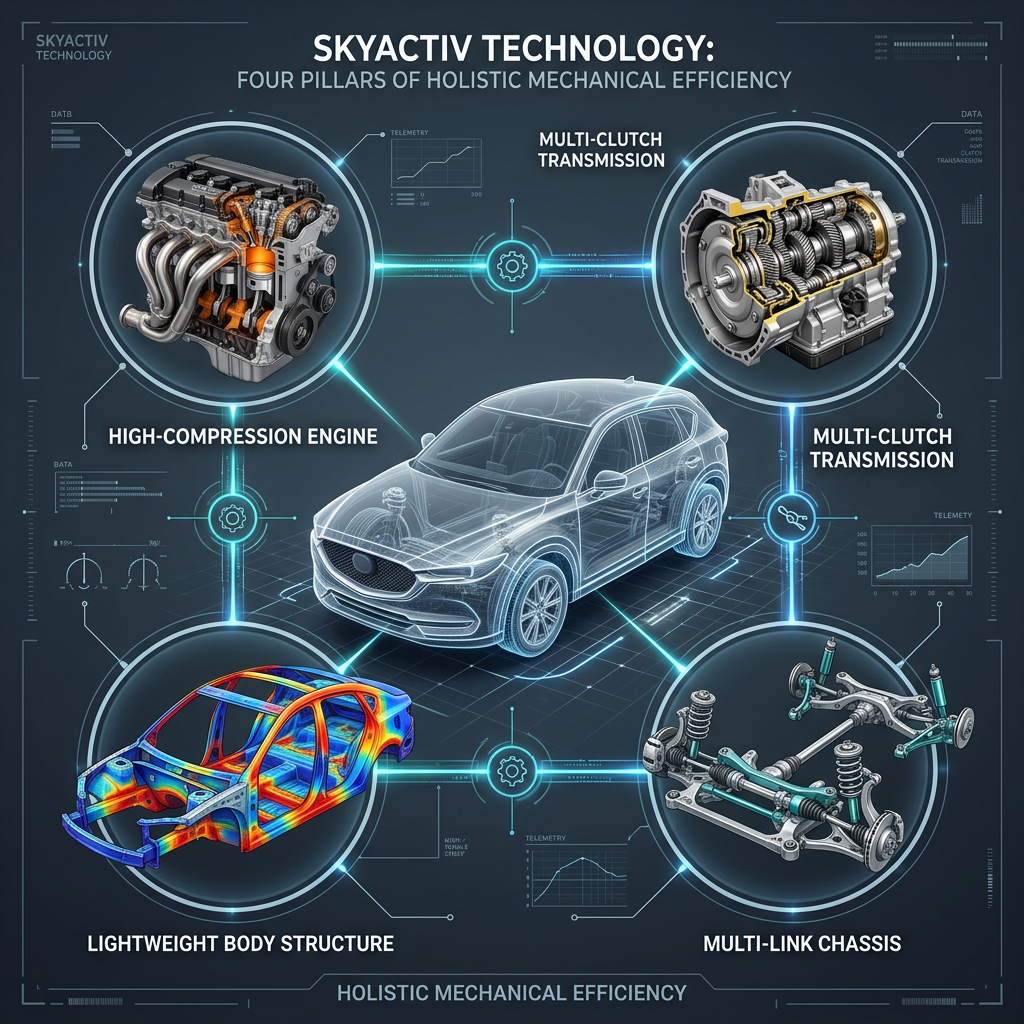
Mazda's engineers rejected that compromise. They asked a fundamental physics question: why throw away 70% to 80% of the chemical energy locked inside gasoline as wasted heat and internal friction? Skyactiv Technology was born from an obsession with base combustion physics, structural mass reduction, and direct mechanical coupling. The framework incorporates four interconnected pillars: Skyactiv-G and Skyactiv-X powertrains, the Skyactiv-Drive stepped automatic gearbox, the lightweight Skyactiv-Body, and the geometrically optimized Skyactiv-Chassis.
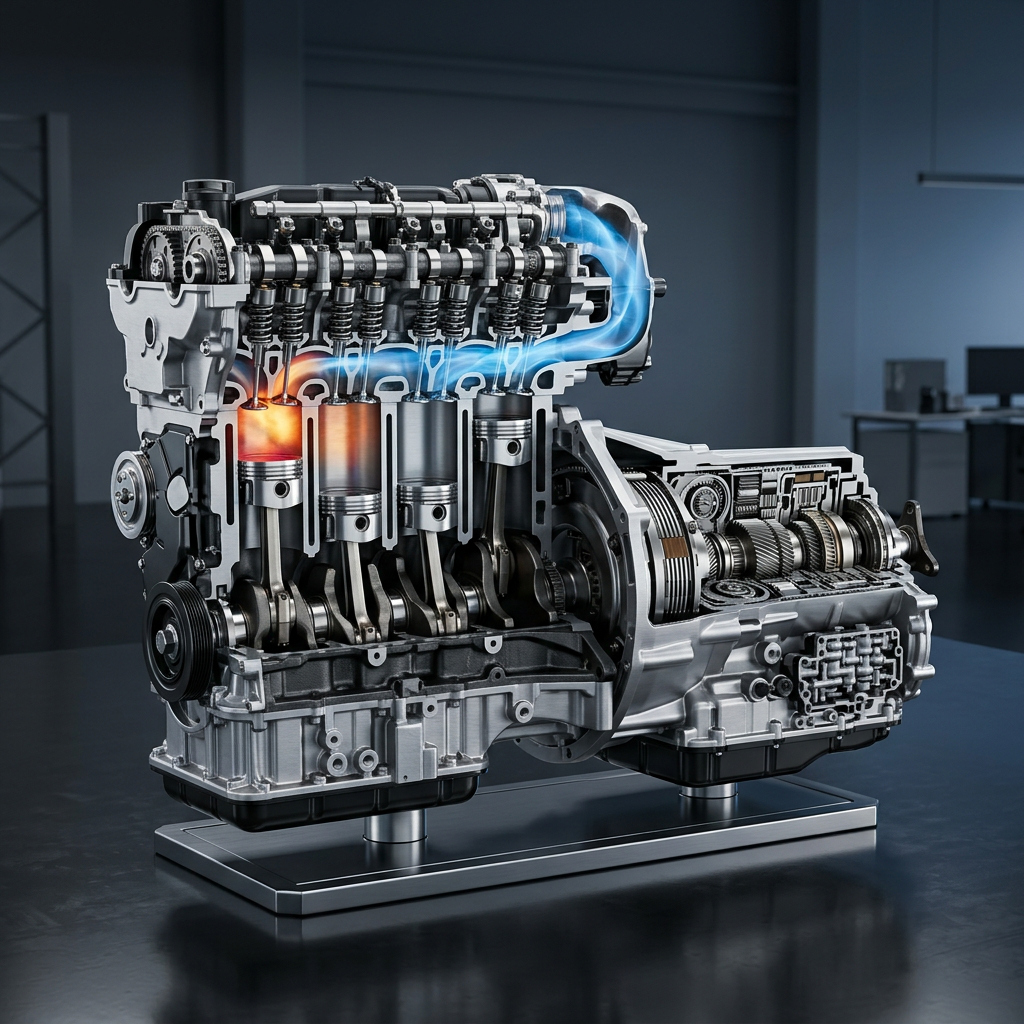
By re-engineering the 4-2-1 exhaust manifold to scavenge hot exhaust gases and eliminate engine knock, designing cavity-shaped piston crowns, and adopting multi-hole direct injectors capable of atomizing fuel at extreme pressures, Mazda extracted massive thermodynamic improvements. Because the entire vehicle was engineered in harmony, the engine works less to push the car, the transmission transmits power without slipping hydraulic torque converters, and the lightweight chassis places far less physical strain on steering and suspension assemblies over a 150,000-mile lifecycle.
The Four Pillars of Skyactiv:
1. Skyactiv-Engine: Extreme static compression (13:1 to 14:1) with specialized 4-2-1 exhaust headers for maximum thermodynamic expansion without pre-ignition.
2. Skyactiv-Drive: Stepped 6-speed automatic combining the best attributes of conventional automatics, dual-clutch systems, and manuals via wide-range full lockup.
3. Skyactiv-Body: Optimized load paths using up to 1,800 MPa ultra-high tensile steel to boost stiffness by 30% while slicing off 8% of vehicle curb weight.
4. Skyactiv-Chassis: Completely revised front MacPherson struts and rear multi-link geometry designed to harmonize cornering precision with long-term bushing longevity.
Understanding the Engineering: Skyactiv-G, Skyactiv-X, and Skyactiv-D Differences
Mazda's Skyactiv powertrain lineage encompasses three distinct mechanical architectures: Skyactiv-G (gasoline), Skyactiv-X (Spark Controlled Compression Ignition), and Skyactiv-D (clean diesel). Each approach was developed to solve thermodynamic bottlenecks, and each carries specific operating, maintenance, and durability profiles that directly influence long-term ownership costs.
Skyactiv-G (Atmospheric & Turbo)
The cornerstone of Mazda's North American lineup, Skyactiv-G (available in naturally aspirated 2.0L and 2.5L configurations, plus a 2.5L Dynamic Pressure Turbo) runs an astounding 13.0:1 static compression ratio on regular 87-octane fuel. By pairing extended 4-2-1 exhaust runners with multi-hole high-pressure direct injection, it resists thermal detonation while extracting unprecedented work out of every drop of fuel. For owners, this translates into zero exotic maintenance requirements: standard synthetic oil changes, conventional spark plug replacements at 75,000 to 100,000 miles, and no complex hybrid battery packs to degrade over time.
Skyactiv-X (SPCCI Innovation)
Skyactiv-X represents one of the holy grails of internal combustion: Spark Controlled Compression Ignition (SPCCI). Operating at a 16.3:1 compression ratio, this engine uses a lean fuel-air mixture that is ignited primarily by pressure, using a tiny spark plug pulse merely as a timing trigger. It blends the high-revving responsiveness of gasoline with the torquey efficiency and thermal profile of a diesel. While primarily offered in overseas markets due to regional fuel formulations and emissions protocols, its design eliminates diesel particulate fluid while providing 20% to 30% fuel savings under cruising regimes.
Skyactiv-D (Low-Compression Clean Diesel)
While conventional diesels operate at punishing compression ratios near 18:1 or 20:1—requiring heavy cast-iron engine blocks and producing excessive NOx emissions—Mazda engineered Skyactiv-D with a remarkably low 14.4:1 ratio. This allowed engineers to build the block out of lightweight aluminum, reducing front-axle weight and lowering internal frictional resistance by 20%. Variable valve lift on exhaust valves guarantees rapid cylinder warm-up. For long-haul drivers, it offers relentless highway fuel economy, though for suburban Illinois driving, Skyactiv-G remains the lower-cost champion.
Real-World Efficiency: Do Downsized Turbocharged Engines Lose Fuel Economy Faster Under Heavy Load Than Skyactiv?
Over the last decade, automotive marketing pushed a compelling narrative: replace robust 2.5-liter atmospheric engines with diminutive 1.3-liter to 1.5-liter turbocharged units, and drivers would enjoy the fuel economy of a compact city car paired with the torque of a V6. On the EPA laboratory dynamometer—where acceleration is gentle and boost is rarely sustained—these tiny turbo engines produce pristine efficiency ratings. But on actual Midwestern highways, reality tells a far different story.
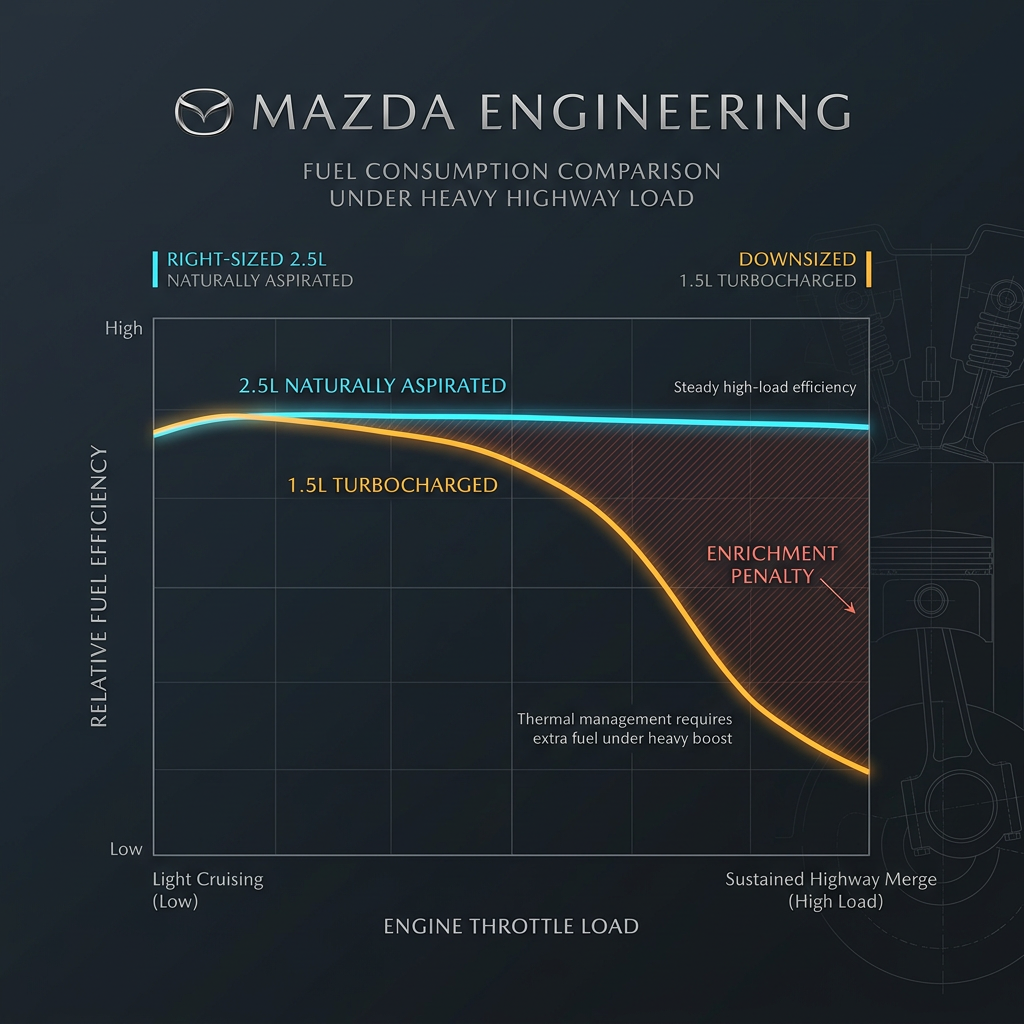
When a downsized turbo engine encounters heavy throttle loads—such as merging onto Interstate 55 during morning rush hour, battling brutal headwinds heading west across Plainfield along Route 126, or passing loaded freight trucks on I-80—the small engine enters high manifold boost pressures. To prevent catastrophic cylinder temperatures and pre-ignition knock, the engine control unit (ECU) performs what automotive engineers call 'fuel enrichment.' It dumps excess liquid gasoline directly into the combustion chamber to act as a chemical cooling agent.
This enrichment penalty causes downsized turbos to see their fuel economy plummet by 25% to 40% under sustained real-world highway driving. In contrast, Mazda's right-sized Skyactiv-G 2.5-liter engine operates in its thermodynamic sweet spot. With ample low-end displacement and high geometric compression, it cruises effortlessly at 75 MPH without entering enrichment modes. You pay for the fuel you actually burn for propulsion, rather than unburned fuel dumped down the exhaust to protect sensitive turbine bearings.
Curious how Mazda's naturally balanced performance feels behind the wheel? Drivers can explore the latest models by taking a moment to browse our new Mazda inventory to compare real-world specifications.
Real-World Efficiency: Load vs. Fuel Burn
|
Driving Condition
|
1.5L Downsized Turbo
|
Mazda 2.5L Skyactiv-G
|
|
Steady 45 MPH Flat Suburban
|
35-37 MPG
|
34-36 MPG
|
|
75 MPH Interstate Commute
|
27-29 MPG
|
32-34 MPG
|
|
Steep Grade / Heavy Payload
|
20-23 MPG (Enrichment)
|
28-30 MPG (Linear)
|
|
Annual Fuel Cost (15k mi)
|
$1,850 - $2,050
|
$1,600 - $1,750
|
How Skyactiv-Body and Skyactiv-Chassis Improve Dynamics and Crash Safety Without Heavy Repair Penalties
Continuous Ring Structures and High-Tensile Steel
Automotive crashworthiness often arrives with a severe weight penalty. Many manufacturers meet strict Insurance Institute for Highway Safety (IIHS) standards by simply adding thick steel gussets and heavy reinforcements around the occupant cell. While effective in collisions, excess mass permanently degrades fuel economy, accelerates brake pad wear, and overburdens suspension ball joints and control arms.
The Skyactiv-Body circumvents this weight spiral through structural architecture rather than raw bulk. Mazda engineered continuous straight-frame sections wherever possible, replacing curved frame members that bend easily under load with uninterrupted, interlocking ring structures around the cabin apertures. Using hot-stamped ultra-high tensile steel rated up to 1,800 megapascals (MPa), Mazda achieved class-topping torsional rigidity while reducing unladen body shell weight by roughly 8%.
Controlling Collision and Wear Expenses
Where many exotic ultra-high-strength steel architectures become nightmares for collision body shops—leading to sky-high insurance premiums and premature vehicle write-offs after minor fender benders—Mazda's modular crush-can design keeps repair costs grounded. Replaceable front sub-frame extensions absorb low-speed impacts up to 9 MPH without transferring deformation into the expensive primary engine cradle or suspension geometry.
On the chassis side, relocated trailing arm pivot points and stiffened front crossmembers dramatically reduce dynamic camber deflection when cornering. By keeping the tire tread flatter against the pavement during aggressive turning or pothole strikes along Will County roads, Mazda Skyactiv models exhibit remarkably symmetrical tire wear, extending tire replacement intervals from 35,000 miles to 50,000+ miles on OEM specifications.
How Does G-Vectoring Control Reduce Passenger Fatigue and Wear on Long Trips?
Long road trips down interstate corridors or daily commutes across the windy open farm country surrounding Plainfield and Shorewood often end with a peculiar sense of fatigue. Most drivers assume this exhaustion is merely psychological, but biomechanical studies reveal it is physical: you are making hundreds of subconscious micro-corrections at the steering wheel every minute to keep the car centered against road crown dips, crosswinds, and surface undulations. Every steering correction forces the passenger's neck and torso muscles to contract to stabilize their head.
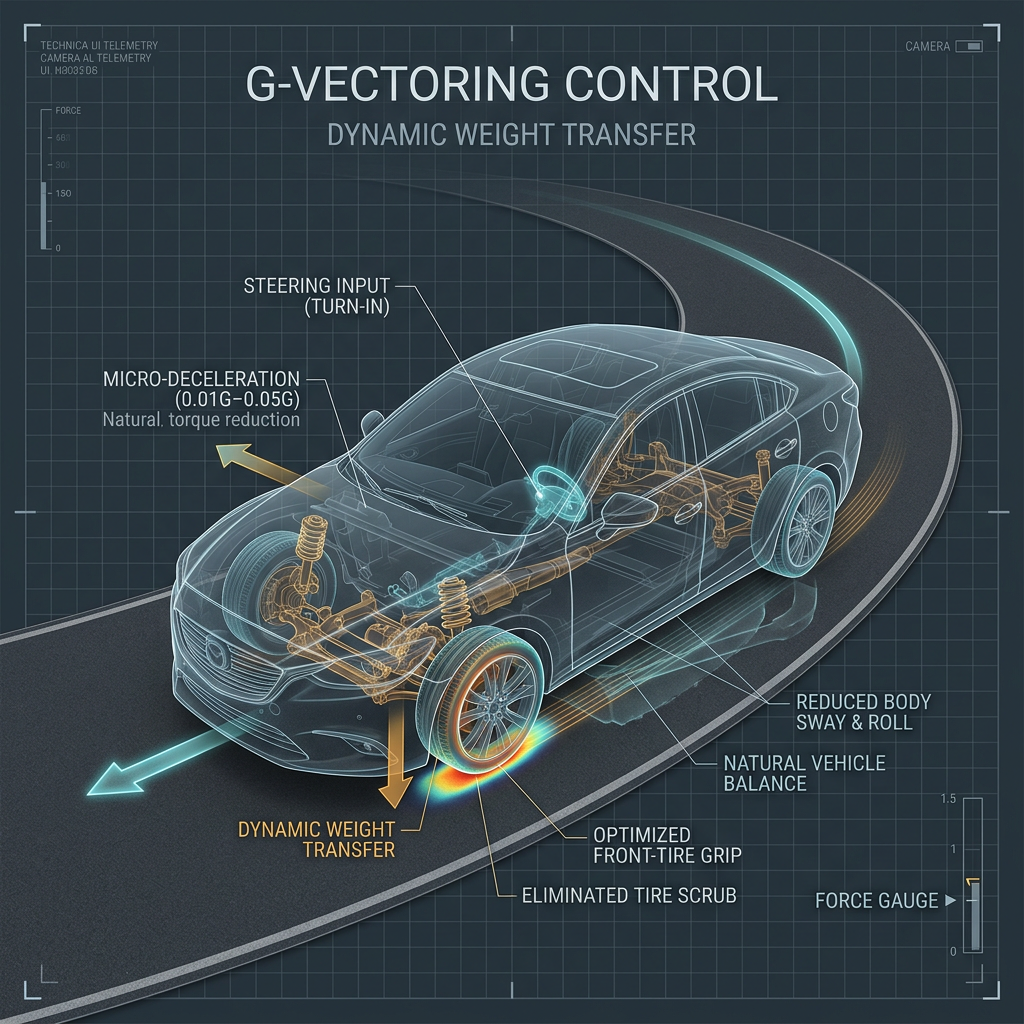
Mazda solved this with an ingenious, software-driven mechanical integration known as G-Vectoring Control (GVC and GVC Plus). Rather than using traditional brake-based stability control—which acts as an anchor by dragging brake pads and burning off kinetic energy—GVC coordinates engine torque with steering angle in real time. The moment you initiate a turn or start correcting for a crosswind, the ECU minutely reduces engine torque output (by an imperceptible 0.01 to 0.05 g of deceleration). This micro-deceleration shifts a tiny fraction of vehicle weight onto the front wheels, increasing front-tire grip and allowing the car to turn in cleanly.
When you exit the corner, GVC restores torque and, in GVC Plus systems, applies light outer-wheel braking to stabilize the vehicle back onto a straight tracking line. The result is a car that tracks true on straightaways without wandering, eliminating countless steering inputs. From an ownership cost perspective, GVC dramatically reduces lateral tire scrubbing—the abrasive sliding action that eats outer tire shoulders—while extending the working life of wheel bearings, tie rods, and steering rack bushings over the car's lifetime.
Scheduled Maintenance vs. Major Overhauls: 100,000-Mile Ownership Cost Breakdown
The true divergence in vehicle ownership expenses happens after the factory warranty expires, typically between 60,000 and 100,000 miles. Many modern compact crossovers incorporate highly stressed mechanical hardware—such as wet-clutch dual-clutch transmissions (DCTs), continuous-variable transmission pushbelts, and high-strung, oil-cooled turbos spinning at 200,000 RPM. When these systems fail, repairs are catastrophic, requiring multi-thousand-dollar total replacements.
0 to 30,000 Miles
Mazda Skyactiv Routine: Clean, simple maintenance. Full synthetic 0W-20 oil changes and OEM filter replacements every 5,000 to 7,500 miles, tire rotations, cabin microfilters, and multi-point safety inspections. No complex specialized fluid flushes or belt adjustments needed.
Competitor Realities: Vehicles with CVT transmissions often require expensive proprietary fluid replacements, while downsized turbo engines often experience early spark plug fouling due to extreme cylinder heat and carbon build-up.
30,000 to 60,000 Miles
Mazda Skyactiv Routine: Engine air filter, brake fluid flush, inspection of brake pads and rotors. Thanks to Skyactiv's lightweight chassis, factory pads frequently last past 45,000 miles. Transmission fluid remains sealed in its heavy-duty housing.
Competitor Realities: Dual-clutch gearboxes often require complete clutch pack calibrations and fluid services costing $600 to $900. Direct-injected turbo competitors without atmospheric port washing often require walnut blasting for intake valve carbon.
60,000 to 100,000 Miles
Mazda Skyactiv Routine: Iridium spark plug replacement, coolant flush, accessory belt replacement. Skyactiv timing chains are engineered for the vehicle's lifespan, eliminating costly timing belt services.
Competitor Realities: CVTs regularly encounter belt slippage or valve body failure between 80k-100k miles ($4,500-$6,000 replacement). Turbocharger wastegates and oil seals frequently degrade, requiring $2,200+ in turbo overhauls.
Keeping your Skyactiv vehicle running at peak efficiency is simple when maintained by factory-trained technicians. When you are due for regular maintenance or routine inspections, you can easily schedule your service today with certified professionals.
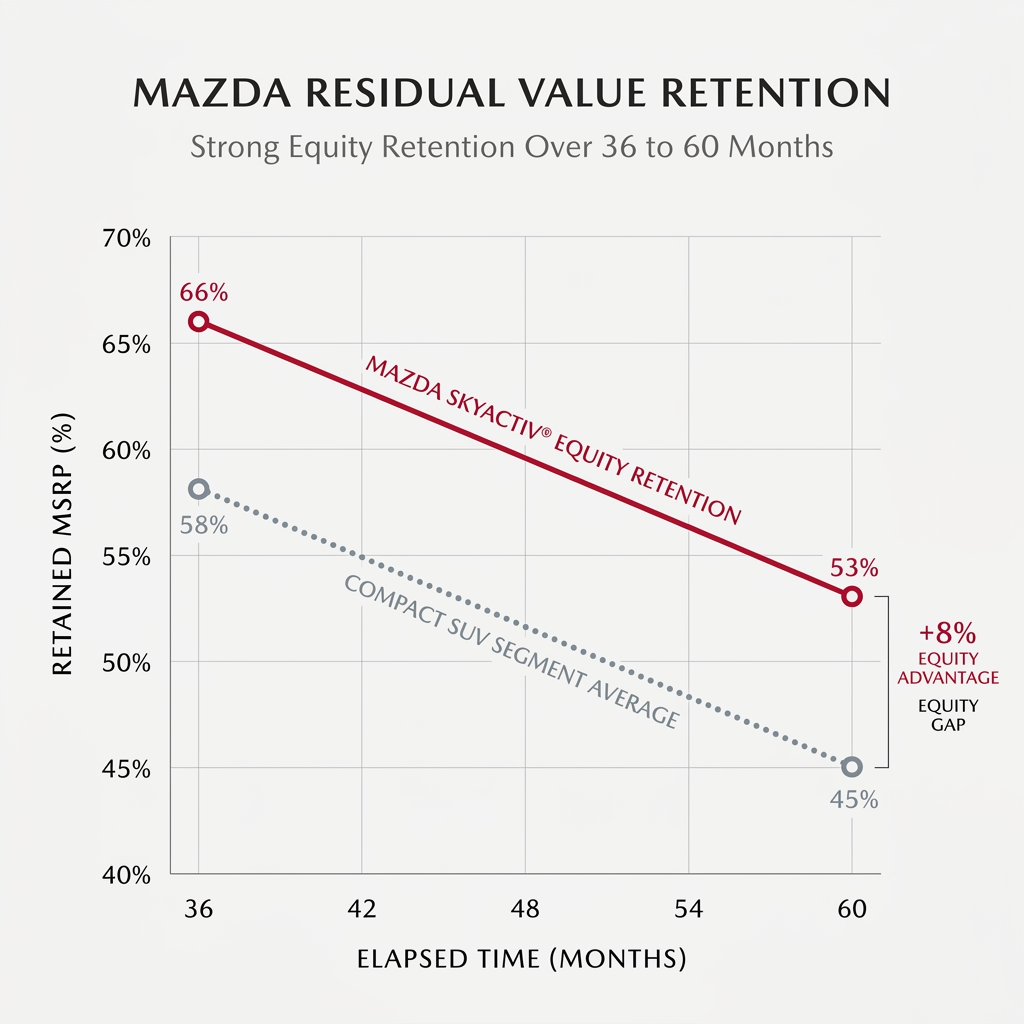
How Do Skyactiv Mazda Models Retain Resale Value After 36 to 60 Months?
Depreciation is overwhelmingly the single largest expense of new car ownership, often dwarfing fuel and insurance costs combined. When a vehicle loses 55% of its value in three years, the owner forfeits thousands of dollars in equity. Historically, mainstream brands struggled with rapid residual drop-offs. However, the introduction and maturation of Skyactiv engineering has fundamentally altered Mazda's resale trajectory.
Independent industry residual monitors—including ALG, Kelley Blue Book, and Black Book—consistently rank vehicles like the Mazda CX-5, CX-30, and Mazda3 at the top of their respective segments for equity retention. After 36 months, Skyactiv crossovers routinely preserve 62% to 66% of their original MSRP, beating segment averages by 5 to 8 percentage points. At the 60-month mark, when secondary buyers scrutinize out-of-warranty reliability risks, Mazda models command premium private-party and dealer trade-in values.
Secondary buyers actively seek out Skyactiv vehicles because they lack the notorious failure points that plague other used modern cars: there are no troublesome pushbelt CVTs, no fragile micro-turbos on the verge of bearing failure, and no confusing touchscreen-only interfaces that lock up. When you are ready to upgrade, that sustained market demand translates directly into cold hard equity.
Why Used Car Buyers Pay More for Skyactiv:
• Mechanical Provenance: The Skyactiv-G 2.5L and 6-speed automatic have over a decade of documented real-world durability.
• No CVT Stigma: Used car shoppers deliberately search for traditional geared automatics to avoid transmission failure bills.
• Premium Interior Longevity: High-grade switchgear, durable leatherette/leather trimmings, and quiet acoustic glass resist aging.
• Transferable Equity: Strong trade values protect your down payment on your next vehicle purchase.
Illinois Commute Reality: Surviving Plainfield and Joliet Winter Driving Cycles
Cold Starts, Route 59 Grinds, and Oil Dilution
Suburban Chicago winters pose a brutal test for internal combustion engines. Between sub-zero January deep freezes, stop-and-go crawls along Route 59, and short commuter trips from Shorewood to the Joliet train station, engines spend significant time operating below optimal operating temperatures. In downsized turbo engines, cold cylinder walls cause atomized fuel to condense, washing down past the piston rings and causing severe crankcase fuel oil dilution—a known issue that ruins oil lubricity and destroys bearings.
Mazda engineered Skyactiv engines with rapid-thermal-management coolant control valves and high 13:1 static compression. In cold weather, the engine employs a specialized accelerated warm-up combustion mode that retards ignition timing while splitting fuel injection pulses. This raises exhaust gas temperature instantly, heating the catalytic converter and oil jacket within minutes. Oil reaches full viscosity faster, eliminating fuel washdown and keeping internal friction at a minimum.
i-Activ AWD: Efficiency Without Drag
Traditional all-wheel drive systems represent a major fuel economy penalty. Heavy mechanical center differentials constantly churn thick gear oil, sapping 2 to 4 MPG even on dry pavement. Mazda's i-Activ AWD operates completely differently. It reads 27 external sensors 200 times per second—including ambient outside temperature, wiper activation, steering angle, and individual wheel speeds—to predict wheel slippage before it occurs.
When cruising down I-80 in dry, cold conditions, the electronically controlled coupling sends just enough torque to eliminate driveline lash, operating with 98% front-wheel efficiency. But the instant front traction reduces due to black ice or sleet, torque instantly routes rearward. You get unflinching winter security without paying a heavy gas pump surcharge all winter long.
TCO Comparison: Mazda Skyactiv vs. Direct Competitors Across 5 Years
To illustrate where the $1,800 to $3,200 in operating savings actually originates, we modeled a realistic 5-year, 75,000-mile ownership projection. This comparison pits a Mazda CX-5 (Skyactiv 2.5L / 6-speed Automatic) against two common compact SUV rivals: Competitor A (1.5L Downsized Turbo with CVT) and Competitor B (1.5L Turbo with 7-Speed Dual-Clutch). All models are evaluated under identical suburban commute assumptions.
|
Ownership Expense (5 Years / 75k Miles)
|
Mazda CX-5 (Skyactiv-G)
|
Competitor A (1.5T + CVT)
|
Competitor B (1.5T + DCT)
|
|
Estimated Fuel Expenditure
|
$8,650
|
$9,450
|
$9,200
|
|
Scheduled Maintenance & Fluids
|
$1,450
|
$2,100
|
$2,650
|
|
Brakes, Rotors & Tires (Consumables)
|
$1,350
|
$1,650
|
$1,700
|
|
Unscheduled Repairs & Diagnostics
|
$250
|
$850
|
$1,200
|
|
Depreciation (Loss from MSRP)
|
$11,200
|
$12,900
|
$13,400
|
|
Total Estimated 5-Year Operating Cost
|
$22,900
|
$26,950
|
$28,150
|
|
Skyactiv Financial Advantage
|
Baseline
|
+$4,050 Savings
|
+$5,250 Savings
|
1. Fuel & Thermal Reality
While Competitor A advertises a higher EPA rating, real-world highway commuting triggers heavy fuel enrichment. Mazda's 13.0:1 atmospheric compression delivers stable, predictable mileage regardless of wind or payload.
2. Friction & Fluid Care
Dual-clutch and CVT setups demand specialized synthetic hydraulic fluids and frequent calibrations. Skyactiv-Drive's multi-plate lockup clutch minimizes fluid shearing, protecting vital internal gears.
3. Residual Equity Power
When trading in after 60 months, Skyactiv models retain higher resale value. You can find out what your current car is worth right now by choosing to get your trade-in value online before shopping.
Smart Buyer Checklist: Maximizing Your Skyactiv Investment From Day One
To guarantee that your Mazda delivers every dollar of its engineered cost-of-ownership advantage past the 150,000-mile mark, follow these practical ownership guidelines:
1. Fuel Octane Requirements: For naturally aspirated Skyactiv-G 2.0L and 2.5L engines, standard 87-octane regular unleaded is completely optimized by the 13.0:1 combustion chamber. There is zero mechanical benefit to paying a 70-cent premium for 93-octane. On 2.5L Turbo models, 87-octane delivers 227 horsepower and 310 lb-ft of torque; 93-octane unlocks 256 horsepower and 320 lb-ft. Choose regular for daily commuting to save hundreds annually.
2. Oil Viscosity & Filter Flow: Always use API-certified 0W-20 full synthetic oil paired with Genuine Mazda OEM oil filters. Mazda's high-pressure hydraulic lifters and dual dynamic variable valve timing rely on exact oil bypass pressures that standard aftermarket filters can disrupt.
3. Spark Plug Longevity: Do not swap spark plugs prematurely, but never exceed 100,000 miles. High-compression direct injection requires high-energy spark discharge; stick with laser-iridium factory specifications.
4. Tire Rotation Discipline: Rotate tires every 5,000 to 7,500 miles. Although G-Vectoring Control minimizes cornering shoulder scrub, regular front-to-rear rotations ensure even tread depth across all four corners, protecting the i-Activ AWD differential clutches.
5. Certified Pre-Owned Consideration: If you want to bypass initial vehicle depreciation while enjoying full factory backing, you can shop certified pre-owned Mazda models that undergo rigorous 160-point mechanical audits and include extended powertrain warranty protection.
Evaluate Long-Term Skyactiv Value at Hawk Mazda in Plainfield
Engineering theory is proven on the asphalt. At Hawk Mazda, we invite drivers across Plainfield, Shorewood, Joliet, and Naperville to experience how Mazda's Skyactiv philosophy translates into tangible driving pleasure and unmatched long-term financial sanity. Whether you are looking to test-drive an agile Mazda CX-30, step inside the award-winning CX-5, or experience the spacious three-row CX-90, our dedicated team is here to assist you at every step of your ownership journey.
Visit our state-of-the-art showroom conveniently located at 2421 S Route 59 in Plainfield, IL 60586. If you need step-by-step navigation, easily get directions to Hawk Mazda from anywhere in Will County. Have questions regarding current inventory information? Don't hesitate to give our friendly team a direct call at (779) 260-6502. If you would like to discuss financing options before your visit, please contact us.