Does Mazda i-Activ AWD Perform as Well as Traditional 4WD in Deep Snow?
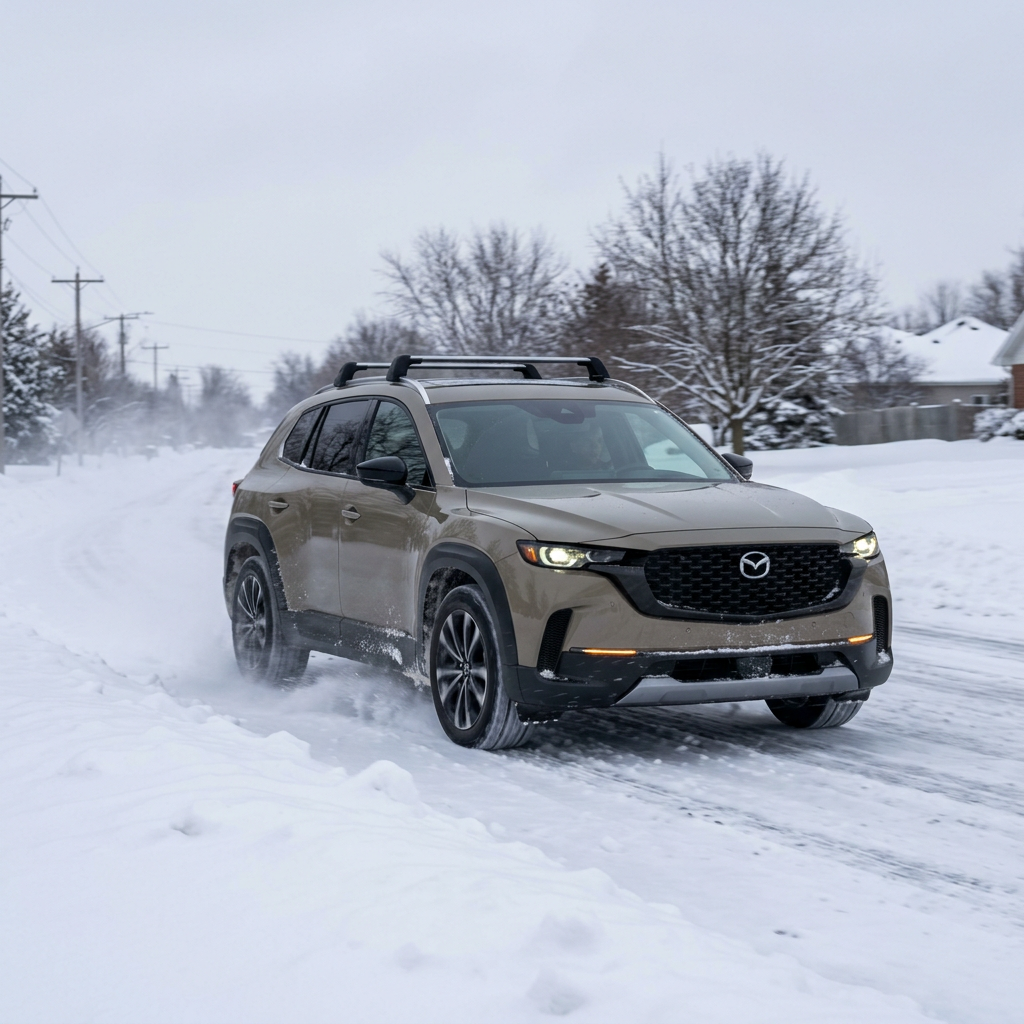
When heavy winter storms hit Plainfield, Joliet, and surrounding Will County, northern Illinois drivers face a critical question: can a modern crossover equipped with Mazda i-Activ AWD truly match the deep snow capability of a heavy traditional four-wheel-drive (4WD) system? The short answer is a resounding yes—and in many real-world winter driving scenarios, Mazda's intelligent system actually outperforms legacy mechanical 4WD. For deep snow on both paved arterial roads and unpaved suburban routes, Mazda i-Activ AWD delivers equal traction, exceptional stability, and superior vehicle control compared to traditional 4WD. While legacy 4WD systems rely on drivers manually engaging low-range transfer cases—which can cause driveline binding, tire scrub, and sluggish steering response—Mazda's predictive i-Activ AWD operates continuously and invisibly. Utilizing 27 electronic sensors monitoring vehicle dynamic data 200 times per second, i-Activ AWD transfers optimal engine torque to the rear wheels before front-wheel slip ever takes place. Combined with Mazda's Off-Road Traction Assist mode, the system effectively mimics a locked mechanical center differential, ungluing your vehicle from thick snowbanks while maintaining superior fuel efficiency and effortless daily drivability.
|
System Feature
|
Mazda i-Activ AWD
|
Traditional Mechanical 4WD
|
|
Driver Activation
|
100% Automatic & Predictive
|
Manual Shift / Electronic Switch Required
|
|
Response Latency
|
Zero-slip proactive routing (200x/sec)
|
Reactive engagement after wheel spin
|
|
Dry Pavement Safety
|
Seamlessly active on all surfaces
|
Requires disengagement to prevent binding
|
|
Fuel Efficiency
|
Optimized front-drive bias when cruising
|
Higher mechanical drag & rotational mass
|
|
Deep Snow Extraction
|
Off-Road Traction Assist braked-wheel vectoring
|
Low-range gear reduction & mechanical lock
|
How Does Mazda i-Activ AWD Function During Freezing Winter Weather in Illinois?
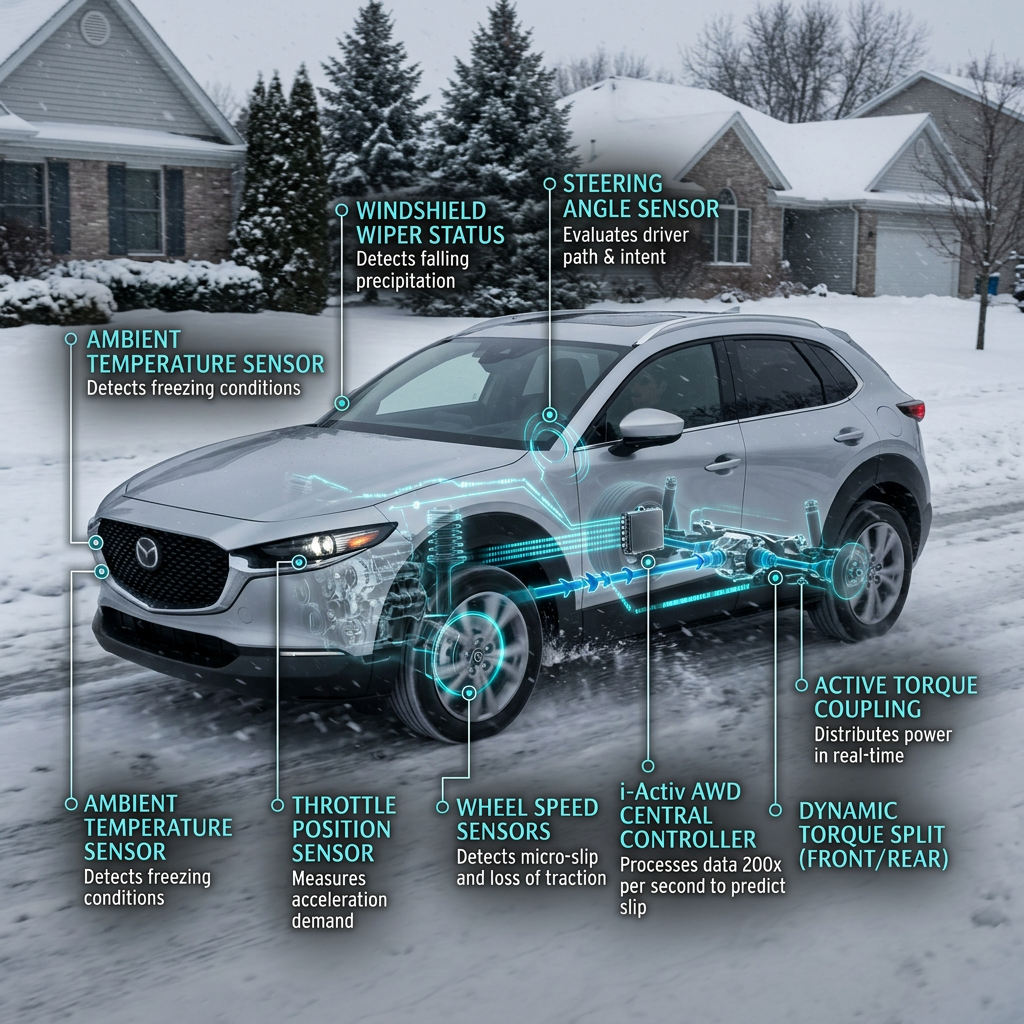
Traditional all-wheel-drive systems are purely reactive: they wait for front wheel spin before sending power to the rear axle. In freezing Illinois weather, that fraction of a second of delay can mean losing lateral stability on slick slush or sliding sideways at a stoplight along Route 59. Mazda's i-Activ AWD takes an entirely different, predictive engineering approach. The system constantly monitors a network of 27 distinct micro-sensors sampling road conditions, environmental factors, and driver inputs 200 times per second. Key data inputs include: • Ambient Outside Temperature: Detects when freezing conditions threaten road surfaces. • Windshield Wiper Status: Identifies falling snow, sleet, or freezing rain. • Steering Angle & Yaw Rate: Calculates the driver's intended direction of travel. • Throttle & Brake Pressure: Anticipates immediate torque requirements. • Individual Wheel Speed Micro-Slip: Detects minute fractional rotation discrepancies between front and rear axles. By synthesizing these metrics, i-Activ AWD calculates road grip in real time, routing precise power to the rear wheels via an electronically controlled electromagnetic clutch pack before the front tires ever begin to slip.
Mazda Predictive AWD vs. Traditional 4WD: How They Handle Deep Snow Drifts
Deep snow drifts created by high winds across open Midwestern fields present two main challenges: mechanical ground clearance and traction distribution. Traditional 4WD trucks utilize rigid mechanical transfer cases that lock front and rear driveshafts together at a fixed 50/50 ratio. While effective in deep mud, this rigid coupling makes low-speed maneuvering through tight suburban snowbanks difficult and prone to front-wheel push (understeer). Mazda i-Activ AWD crossovers—such as the Mazda CX-5, CX-50, and CX-90—combine generous ground clearance (up to 8.6 inches on CX-50) with optimized weight distribution and intelligent electronic torque vectoring. Rather than forcing all four wheels to turn at identical speeds regardless of turn radius, i-Activ AWD constantly varies front-to-rear power distribution from 100:0 to 50:50, allowing sharp turning and controlled path correction even in heavy unplowed drifts.
When a vehicle gets high-centered or stuck in an uneven snow bank where one wheel loses contact with solid ground, standard open differentials send all engine power to the slipping wheel, causing it to spin uselessly. To overcome this, Mazda engineers developed Off-Road Traction Assist. When activated in deep snow, the vehicle's ABS modules instantly brake the spinning, low-traction wheel while simultaneously directing engine torque to the remaining grounded tires. This electronic simulation of a mechanical differential lock allows Mazda AWD vehicles to pull themselves out of heavy, wet snowbanks that would strand typical passenger vehicles.
Explore Snow-Ready Mazda i-Activ AWD Inventory in Plainfield
Ready to experience winter confidence firsthand? Hawk Mazda in Plainfield offers an exceptional selection of winter-ready AWD crossovers. Whether you are looking for the compact agility of the CX-30, the refined versatility of the CX-5, the rugged capability of the CX-50, or three-row family luxury in the CX-90, our team is ready to assist you. Take advantage of seasonal test drive availability on snow-covered roads to feel the predictive i-Activ AWD system in real winter conditions. You can Browse New Mazda Inventory or explore our certified options when you Shop Certified Pre-Owned Mazda right online.
How Does Improper Tire Pressure Impact Mazda i-Activ AWD System Health?
Sub-zero temperatures in Will County cause atmospheric air contraction, reducing tire inflation pressure by approximately 1 to 2 PSI for every 10-degree drop in ambient temperature. While many drivers consider underinflated tires a minor inconvenience, uneven tire pressure poses a direct mechanical risk to high-precision AWD systems. When one tire drops significantly in pressure, its overall rolling circumference decreases compared to the other three wheels. Because i-Activ AWD measures wheel speed down to fractions of a revolution, mismatched tire diameters trick the vehicle computer into sensing continuous front-wheel slip. This triggers constant engagement of the Power Transfer Unit (PTU) and rear electromagnetic coupling. Over prolonged distances, this continuous micro-clutch slippage generates excessive thermal stress inside the PTU and rear differential, breaking down gear oil viscosity and potentially illuminating the AWD system warning light.
What Type of Engine Coolant Do Mazda Vehicles Require?
Genuine Mazda FL22 Coolant Mazda vehicles require genuine FL22 pre-mixed long-life coolant. Formulated specifically for Mazda aluminum engine blocks, FL22 uses advanced organic acid technology (OAT) free of silicates and borates to prevent internal cooling channel scale accumulation.
-40°F Freeze Protection During Northern Illinois winter polar vortexes, coolant integrity is vital. Pre-mixed 55/45 FL22 formula protects engine blocks from freeze cracking, heater core freeze-up, and water pump cavitation down to extreme sub-zero temperatures.
Dangers of Non-Spec Coolant Mixing generic green or universal store-bought antifreeze with FL22 causes chemical gel precipitation. This gelling blocks narrow cabin heater core passages, reduces interior heating efficiency, and induces localized engine overheating.
What Is the Typical Cost of Replacing Mazda AWD Rear Differential Fluid?
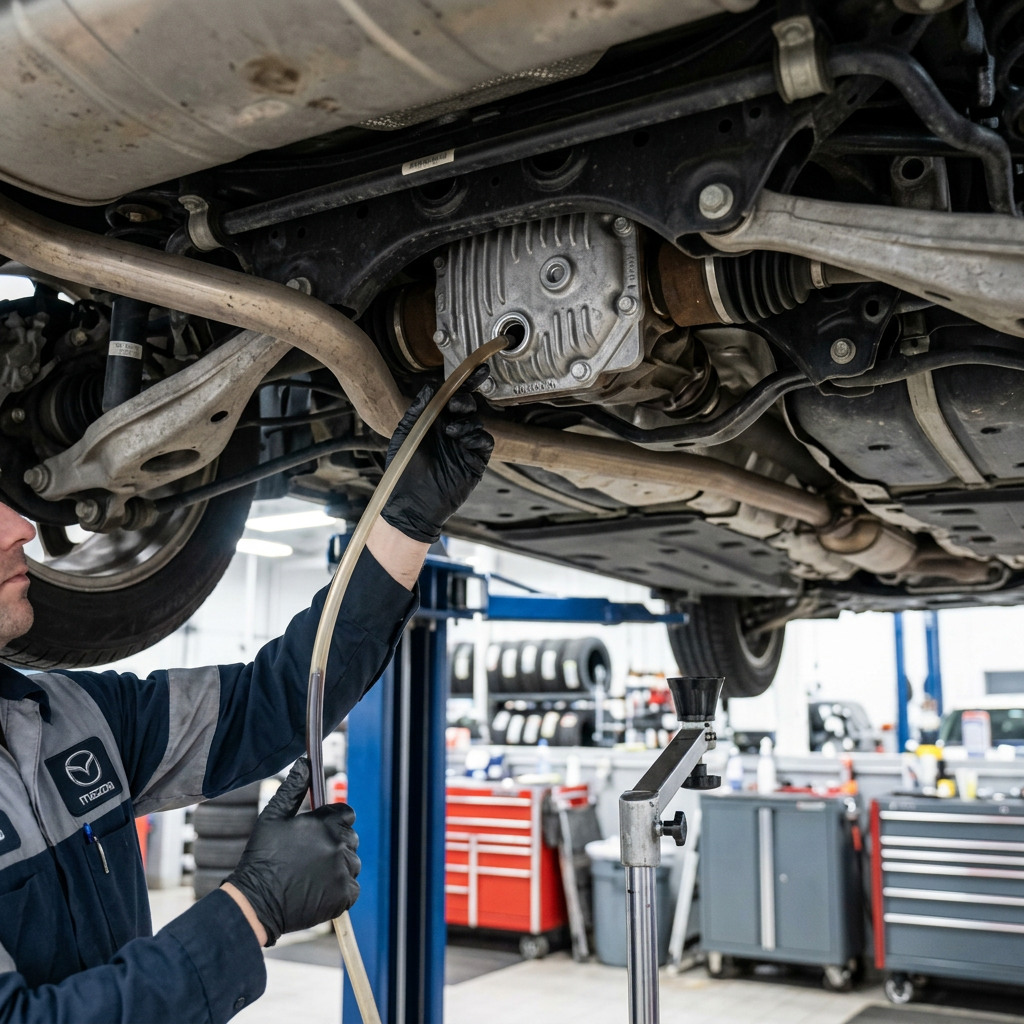
Maintaining fresh differential fluid is one of the most critical services for preserving long-term AWD performance in cold climates. • Service Cost Range: A professional Mazda rear differential fluid drain and fill typically ranges between $150 and $300, depending on model year and whether transfer case fluid is serviced concurrently. • Recommended Interval: Mazda recommends inspecting drivetrain fluids every 30,000 miles and replacing rear gear lube every 30,000 to 60,000 miles—or sooner under severe driving conditions like heavy snow, towing, or frequent stop-and-go winter commuting. • Cold Weather Vitality: Severe winter cold thickens aged gear oil. Fresh OEM full-synthetic gear lubricant ensures immediate hydraulic coupling engagement and smooth torque delivery on icy morning starts.
Autumn to Winter Mazda AWD Inspection Checklist for Plainfield, Joliet, and Oswego Drivers
1. Battery & CCA Test Sub-zero weather reduces chemical battery activity by up to 50%. A battery load test verifies Cold Cranking Amps (CCA) to guarantee dependable engine starting on frigid Plainfield mornings.
2. Winter Fluid Top-Offs Replenish genuine Mazda FL22 coolant and fill windshield washer reservoirs with -20°F de-icing washer fluid to keep windshields clear of road salt slurry along I-55.
3. Wipers & Drivetrain Checks Replace worn wiper blades with heavy-duty winter beam blades and inspect Power Transfer Unit (PTU) seals for micro-sweating before snow season starts.
What Key Components Should Be Included in an Autumn-to-Winter Mazda AWD Inspection Checklist?
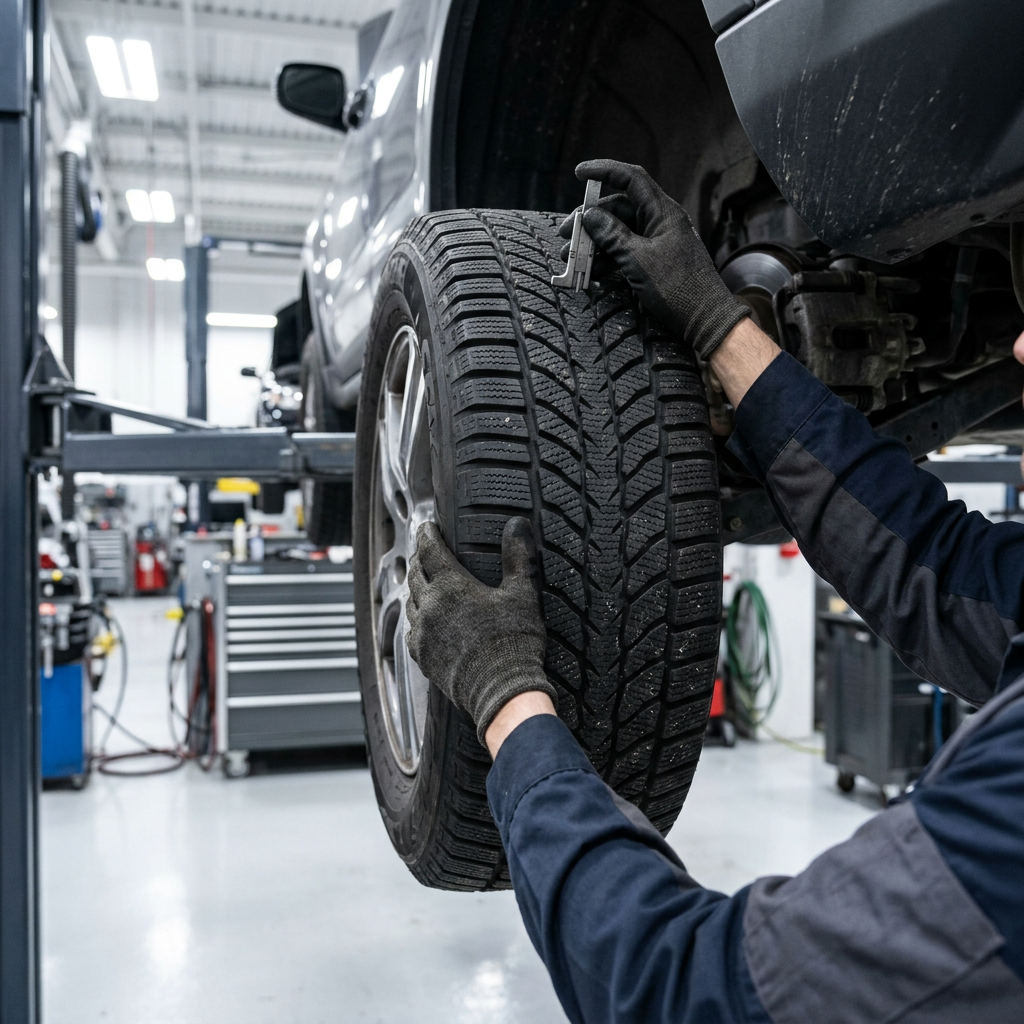
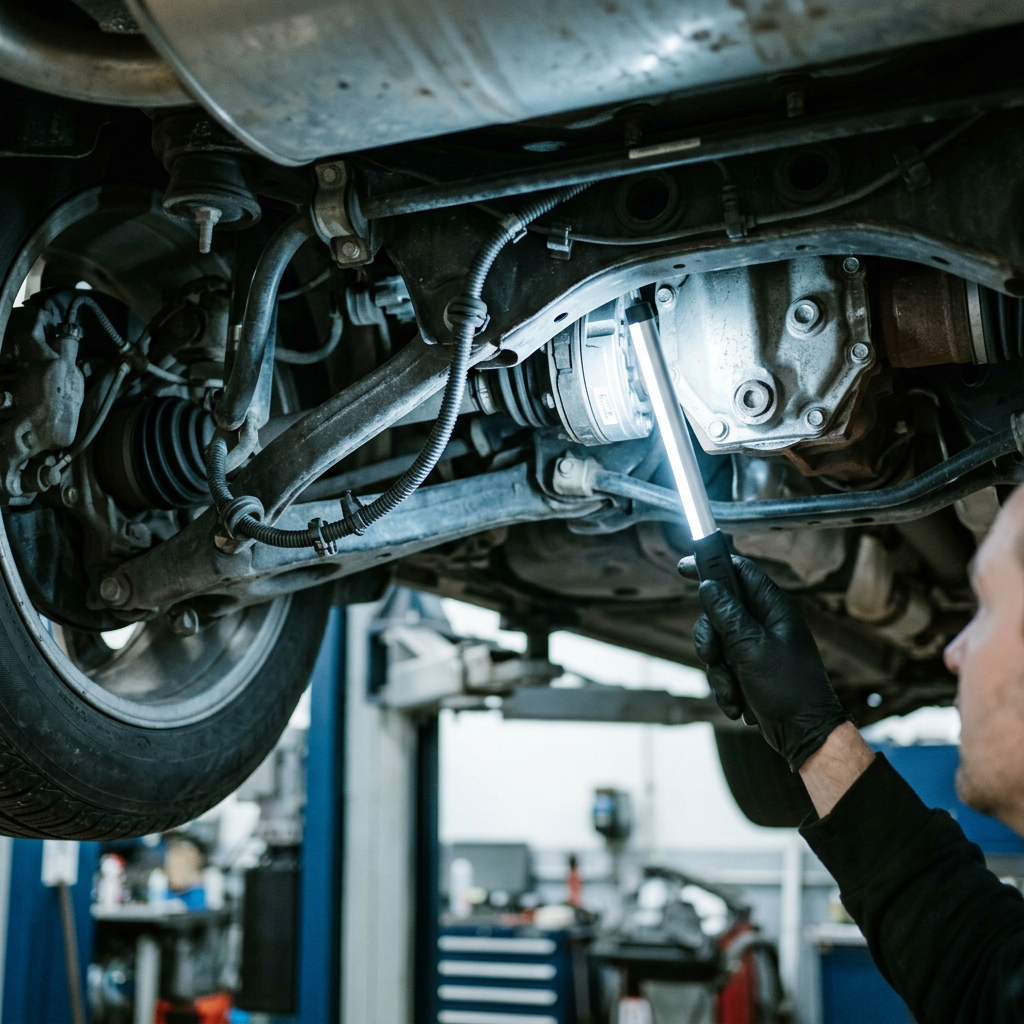
A thorough winter inspection goes far beyond checking engine oil. For optimal AWD reliability, certified technicians inspect five core mechanical and electronic areas: 1. Wheel Speed Sensors & Wiring Harnesses: Road salt and ice accumulation can corrode wheel speed sensor connections. Clean sensor readings are required for i-Activ AWD predictive torque calculation. 2. Electromagnetic Rear Clutch Coupling Harness: Inspect electrical connectors feeding the rear axle coupling for insulation tears or moisture intrusion. 3. PTU & Rear Differential Shaft Seals: Fluid seal elasticity decreases in freezing weather. Pre-winter checks ensure no gear lube leaks occur under thermal cycles. 4. Brake Rotor & Caliper Slide Pins: De-icing salts induce caliper pin binding. Lubricated slide pins ensure even brake application during Off-Road Traction Assist wheel braking. 5. Tire Tread Depth & Wear Uniformity: AWD systems require minimum 4/32" tread depth (6/32" recommended for deep snow) across all four tires with uniform outer circumference.
Navigating Snow and Ice Drifts Around Shorewood and the DuPage River Valley
Commuting through Will County during a winter storm presents distinct terrain challenges. Rolling topography around the DuPage River valley, elevated overpasses on Interstate 55, and open agricultural winds along Route 126 create sudden black ice patches and high snow drifts. Mazda's integrated G-Vectoring Control Plus (GVC Plus) works seamlessly alongside i-Activ AWD to enhance vehicle stability in these exact conditions. As you steer around icy curves or correct your path in crosswinds, GVC Plus makes minute reductions in engine torque to shift weight to the front tires, boosting cornering grip. As you exit the turn, it lightly applies brake force to the outer wheels to stabilize the chassis.
Practical Winter Driving Tips for i-Activ AWD:• Maintain Momentum: Allow i-Activ AWD to manage wheel slip automatically—avoid pumping the accelerator in deep snowdrifts. • Smooth Steering Inputs: i-Activ predictive sensors read steering angle change; smooth inputs allow the system to anticipate torque distribution accurately. • Value Your Vehicle: Thinking about upgrading to an AWD crossover before winter peaks? Get Your Trade-In Value online in minutes.
Pairing i-Activ AWD with Winter Tires for Ultimate Snow Performance
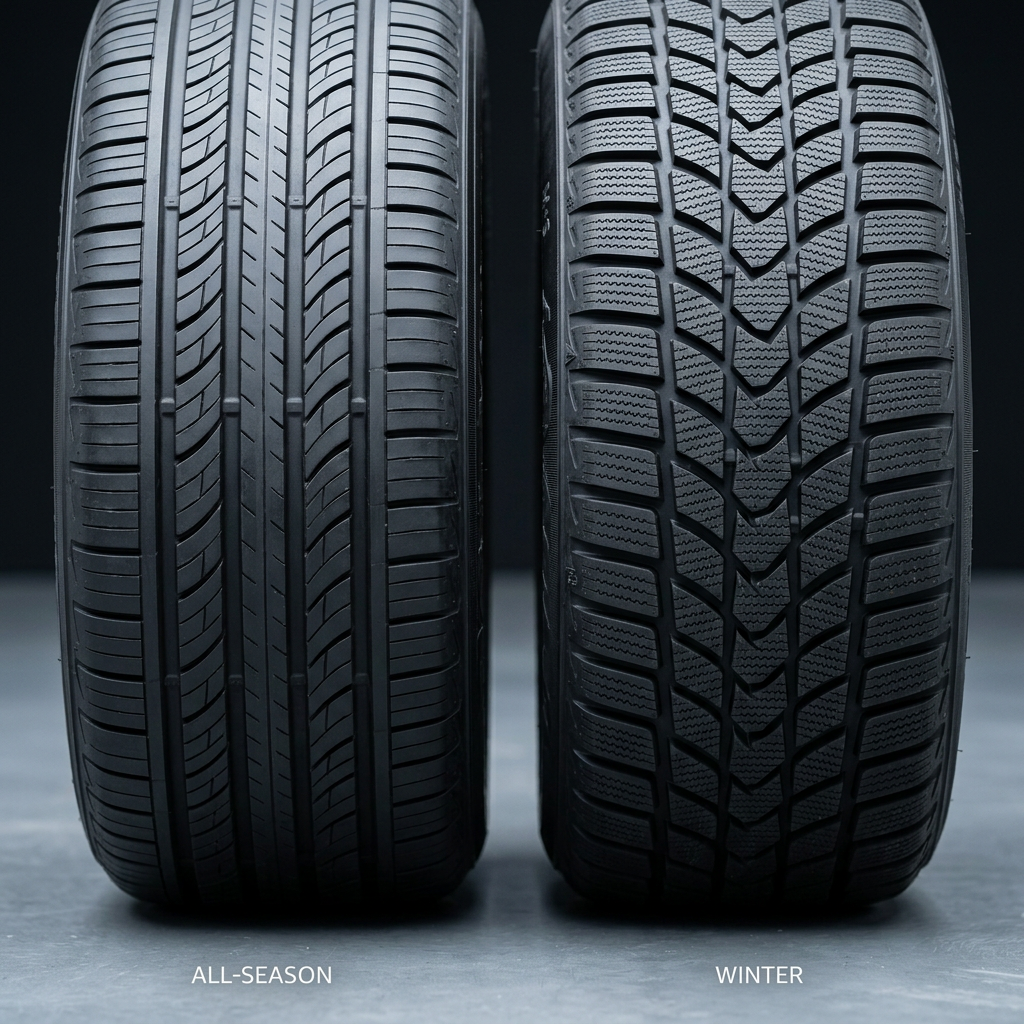
While Mazda i-Activ AWD is remarkably capable with factory all-season tires, pairing intelligent AWD with dedicated 3-Peak Mountain Snowflake (3PMSF) rated winter tires transforms your vehicle into an unstoppable winter machine. All-season tire rubber compounds harden when ambient temperatures drop below 45°F, reducing mechanical grip even on dry pavement. In contrast, specialized winter tires utilize hydrophilic silica compounds that remain flexible in sub-zero cold, combined with high-density siping that bites into packed snow and ice. When combined with Mazda i-Activ AWD, winter tires dramatically reduce braking distances by up to 30% on glare ice and provide unmatched lateral cornering control.
Schedule Your Winter Mazda AWD Service or Test Drive at Hawk Mazda Today
Don't wait for the first major winter blizzard to discover if your vehicle is ready for deep snow. Trust the factory-certified technicians at Hawk Mazda to inspect your AWD system, perform rear differential fluid maintenance, install winter tires, or check your battery health. Drivers in Plainfield, Joliet, Oswego, and Shorewood are invited to visit our showroom to experience the predictive confidence of Mazda i-Activ AWD in person. Get Directions to Hawk Mazda at 2421 S Rte 59, Plainfield, IL 60586, or Call us at (779) 260-6502 to speak with our service or sales teams directly. Ready to get started online? You can easily Schedule Your Service Today, explore genuine accessories when you Order Genuine Mazda Parts, or kickstart your upgrade when you Apply For Financing Now.