How Mazda i-Activ AWD Handles Autumn Rain and Wet Leaves in Northern Illinois
Autumn in Northern Illinois brings stunning foliage, crisp cool mornings, and unique roadway hazards that can turn an ordinary commute into a stressful experience. As leaves accumulate along tree-lined streets in Plainfield, Shorewood, and Joliet, damp overnight dew and sudden October rain showers convert those fallen leaves into a layer as slippery as black ice. Wet leaves drastically reduce tire friction, cutting traction to less than half of normal dry pavement levels. When coupled with standing water in road ruts, drivers routinely face unexpected wheel slip, hydroplaning risk, and unstable steering responses. This is precisely where Mazda's intelligent i-Activ AWD system steps in, providing proactive engineering designed to neutralize autumn driving challenges before you ever feel a tire break traction.
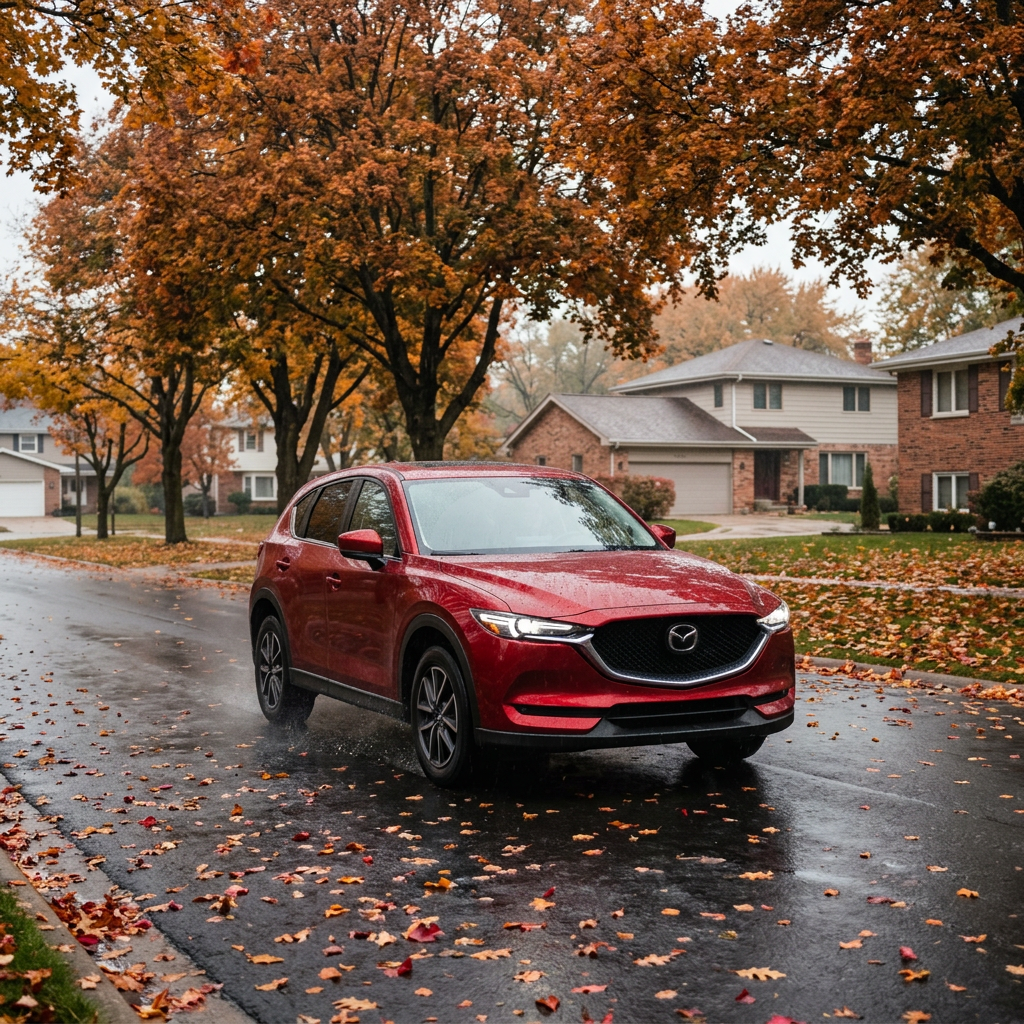
Unlike traditional all-wheel drive setups that wait for a front wheel to slip before engaging the rear axle, Mazda's i-Activ AWD is a predictive system. It samples 27 distinct vehicle sensors 200 times every second to monitor real-time driving conditions. These sensors continuously track variables such as ambient outside temperature, windshield wiper activity, throttle position, steering angle, brake fluid pressure, and individual wheel speed differentials. By synthesizing this massive stream of data, the central vehicle control module detects subtle environmental changes—such as a sudden temperature drop accompanied by high wiper speed—and calculates road slickness instantaneously. The system then transfers optimal engine torque to the rear wheels before front-wheel slippage occurs, ensuring seamless stability, zero torque steer, and predictable control through every twist and turn on your fall commute.
Predictive vs. Reactive Traction: How i-Activ AWD Anticipates Slippery Leaves Before You Skid
To appreciate why Mazda models handle fall weather so effectively, it helps to understand the engineering fundamental separating predictive AWD from traditional reactive AWD. Conventional mechanical or slip-and-grip systems are reactive by design: they operate in front-wheel drive mode until mechanical slip occurs. Only after the front tires lose grip and start spinning on slick wet leaves does a center viscous coupling or electromagnetic clutch engage to send power backward. By the time this mechanical transfer takes place, momentum is momentarily interrupted, causing micro-skids, body destabilization, and driver anxiety.
Mazda's i-Activ AWD flips this paradigm completely by utilizing predictive traction control. The system recognizes ambient outdoor temperature drops that decrease tire rubber flexibility, measures steering angle trajectory toward damp suburban curbs, and monitors driver acceleration inputs. If you pull out onto Route 59 on a rainy 42°F morning, i-Activ AWD pre-loads torque to the rear wheels ahead of acceleration. By matching torque distribution perfectly to real-time surface resistance, Mazda eliminates traction loss before it can initiate, providing an effortless sense of confidence behind the wheel.
|
System Architecture
|
Traditional Reactive AWD
|
Mazda i-Activ Predictive AWD
|
|
Monitoring Frequency
|
Passive / Mechanical threshold
|
200 sensor checks per second
|
|
Engagement Timing
|
After wheel slip is detected
|
Before wheel slip can occur
|
|
Key Input Sensors
|
Wheel speed sensors only
|
27 sensors (Temp, Wipers, Steering, G-Force, Throttle)
|
|
Driver Experience
|
Noticeable slip & power thunk
|
Smooth, transparent, uninterrupted traction
|
Does G-Vectoring Control Plus Require Driver Activation or Intervention During Fall Drives?
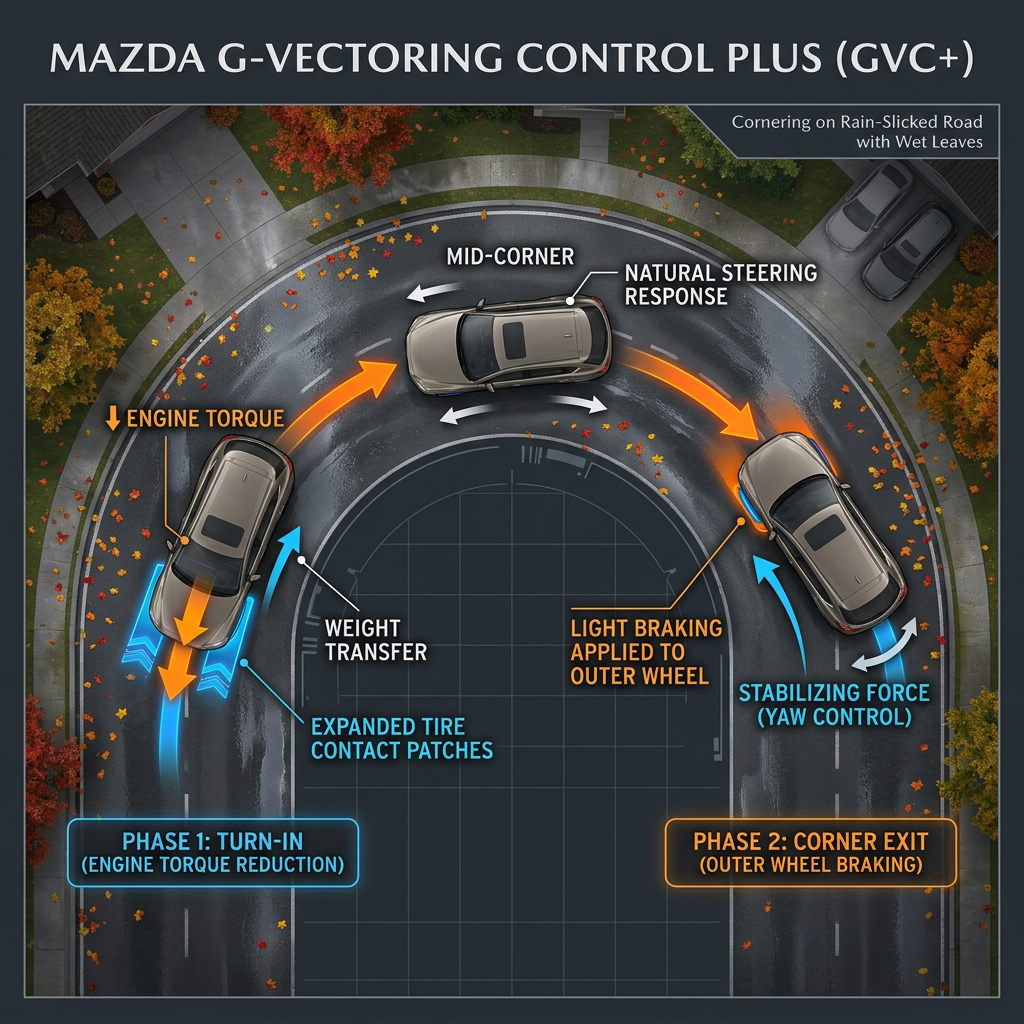
A frequent question from suburban vehicle owners is whether Mazda's signature dynamics feature— G-Vectoring Control Plus (GVC Plus)—requires manually pressing a button or selecting a dedicated rain mode. The answer is a definitive no. GVC Plus operates automatically and continuously in the background whenever your vehicle is in motion, requiring zero driver intervention or system toggles.
When navigating a curved, leaf-strewn residential road in Plainfield, GVC Plus works harmoniously with i-Activ AWD. As you turn the steering wheel into a corner, GVC Plus subtly reduces engine torque by a microscopic fraction. This minute reduction shifts load onto the front tires, increasing front rubber contact patches and turning precision. As you exit the turn, GVC Plus applies slight braking force to the outer wheels to stabilize vehicle alignment. Combined with continuous AWD torque vectoring, the car tracks through slick bends as if on rails without disturbing cabin occupants.
Which Has Better Fuel Economy During Fall Road Trips, Mazda AWD or Subaru AWD?
Fall is prime season for long weekend road trips across the Midwest, from autumn color tours along Starved Rock State Park to scenic highway drives down the Illinois River valley. Drivers comparing all-weather SUVs often weigh Mazda Skyactiv-G AWD against Subaru Symmetrical AWD. While Subaru is renowned for all-wheel capability, its permanent full-time mechanical connection creates continuous internal drag, burning more fuel even on dry, smooth stretches of highway.
Mazda i-Activ Rear-Drive Disconnect
When driving on dry Interstate 55 at cruising speeds where extra traction isn't needed, i-Activ AWD automatically disengages power flow to the rear differential. This reduces mechanical drag by up to 80% compared to traditional full-time AWD setups.
Subaru Symmetrical Drag
Subaru's Symmetrical AWD keeps power routed through a complex center differential to all four wheels 100% of the time. While effective in deep snow, it incurs constant parasitic drivetrain loss that degrades highway MPG during fall road trips.
Real-World Efficiency Gains
Mazda Skyactiv-G engines paired with i-Activ AWD offer superior highway fuel economy ratings without compromising foul-weather capability. Drivers enjoy maximum fuel savings when roads are dry, with instant traction response the moment rain begins.
|
Segment / Vehicle Comparison
|
Mazda AWD EPA Rating (Highway)
|
Subaru AWD EPA Rating (Highway)
|
Highway Efficiency Edge
|
|
Compact Crossover (CX-30 vs Crosstrek)
|
Up to 33 MPG
|
Up to 33 MPG
|
Equal (Mazda higher horsepower)
|
|
Midsize Crossover (CX-5 vs Forester)
|
Up to 30 MPG
|
Up to 29 MPG
|
Mazda +1 Highway MPG
|
|
Rugged Crossover (CX-50 vs Outback)
|
Up to 30 MPG
|
Up to 32 MPG
|
Competitive (Mazda higher torque)
|
What Tire Pressure Adjustments Are Necessary for a Mazda When Autumn Temperatures Drop?
As autumn transitions into late October across Will County, overnight temperatures regularly plummet into the 30s. Basic physics dictates that air pressure decreases as ambient temperature drops. For every 10°F drop in temperature, your vehicle's tires lose approximately 1 PSI (pound per square inch) of pressure. A sudden cold snap dropping temperatures by 30 degrees can deflate tires by 3 PSI overnight, illuminating the low pressure warning light on your dashboard.
Under-inflated tires severely impair autumn driving safety. Low PSI causes the tire tread shoulders to flex excessively while shrinking the central contact patch, preventing tire sipes from properly channeling away rainwater and wet leaf slush. To maintain peak traction: check pressures cold in the morning, inflate to the recommended PSI listed on your driver door jamb placard (typically 34–36 PSI depending on model), and reset the Mazda Tire Pressure Monitoring System (TPMS) via the Mazda Connect infotainment menu or TPMS reset button.
What Fall Maintenance Checks Can Help Prepare Your Mazda for Autumn Driving?
Preventative autumn maintenance is your first line of defense against seasonal road hazards. Preparing your Mazda before heavy autumn rainfall and early winter frost ensures your vehicle responds flawlessly when dynamic safety systems are called upon. Below are essential maintenance checks recommended by certified technicians:
1. Brake System Inspection
Stopping on wet leaves requires maximum brake pad friction and smooth rotor engagement. Have pad thickness measured (minimum 4mm recommended) and inspect rotors for rust scoring or heat warping that could impair anti-lock brake performance.
2. Battery Health & CCA Test
Cold weather places heavier electrical loads on your battery for defrosters, heated seats, and wipers. Test battery Cold Cranking Amps (CCA) and clean terminal posts to prevent unexpected morning non-starts.
3. Fluids & Lighting Systems
Top off washer fluid with freeze-resistant winter de-icer blend. Check engine coolant protection levels for sub-zero tolerance. Inspect LED headlights and taillights for clear lenses to ensure full visibility during early sunset commutes.
How Do You Replace Windshield Wiper Blades on a Mazda CX-5 or CX-50?
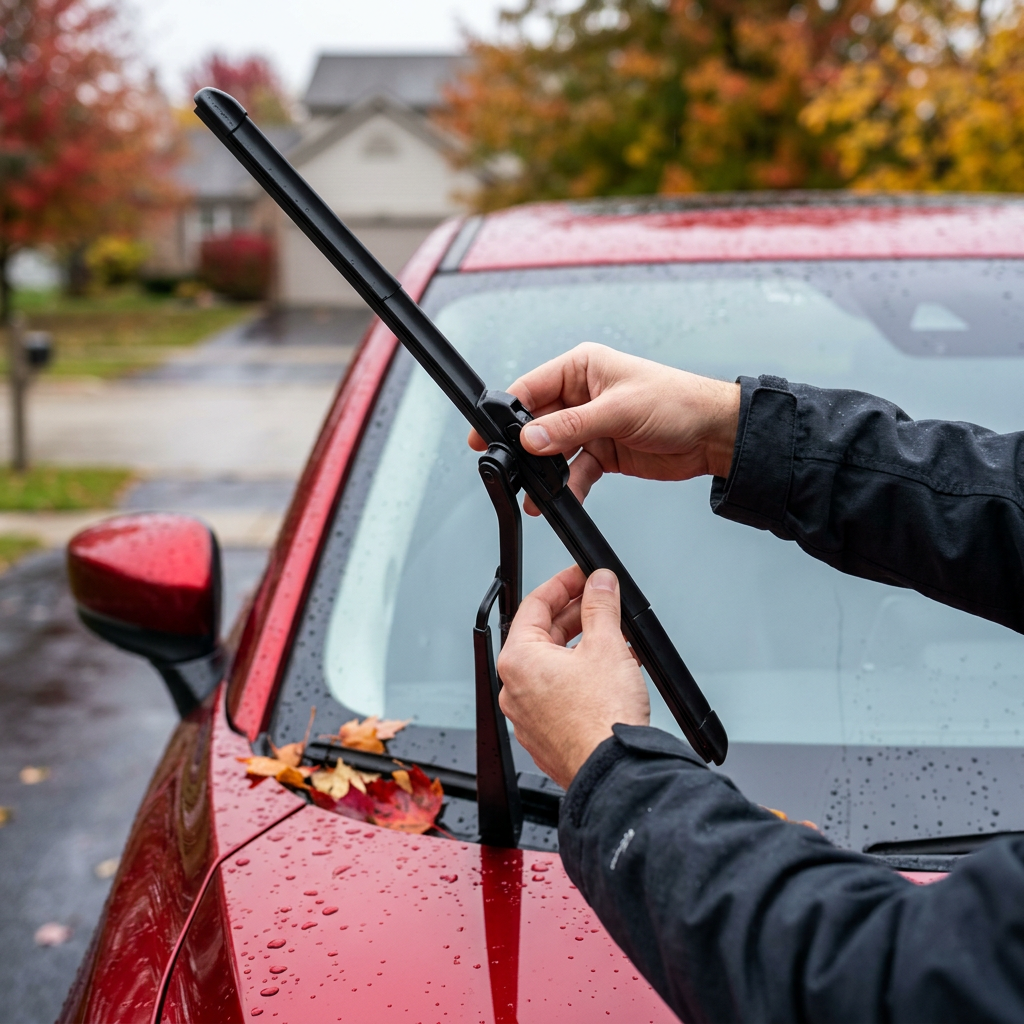
Clear forward vision is paramount when navigating torrential autumn downpours across Plainfield. Changing wiper blades on modern Mazda models like the CX-5 or CX-50 requires engaging Wiper Service Mode so the wiper arms lift safely without contacting the rear edge of the aluminum hood.
Step-by-Step OEM Wiper Replacement Guide:
1. Turn the vehicle ignition ON and then back OFF.
2. Within 30 seconds, press up on the wiper lever (MIST position) twice rapidly. The wipers will move to a vertical service position on the windshield.
3. Lift the wiper arm away from the glass. Depress the small locking tab on the wiper blade connector and slide the old blade off the hook.
4. Align the new OEM Mazda beam blade, press until it clicks securely, and carefully lower the arm back to the glass.
5. Turn ignition ON and operate wipers once to reset them to normal resting position.
Navigating Wet Leaves and Sudden Rains on Plainfield, Shorewood, and Joliet Roads
Drivers throughout Plainfield, Shorewood, and Joliet encounter specific geographic autumn hazards. Local river corridors along the DuPage River trap dense morning ground fog and high humidity, depositing a slick layer of condensation over low-lying pavement. Meanwhile, heavy agricultural transit along county rural roads leaves topsoil and crop dust behind, which turns into ultra-slippery mud when mixed with October downpours.
To stay safe on local suburban routes, increase follow distances to 4-5 seconds when driving under heavy tree canopy coverage on Black Road or Route 126. Avoid abrupt steering inputs or harsh braking on visible leaf mats. If you ever feel your vehicle start to slide, trust your Mazda i-Activ AWD: maintain steady, gentle pressure on the brake pedal (allowing the ABS and torque vectoring to work), and steer smoothly in your intended path of travel.
How Does Buying an AWD Mazda Impact Long-Term Vehicle Resale Value in the Midwest?
High Regional Midwest Demand
In Northern Illinois, all-wheel drive is considered an essential feature rather than a luxury. Pre-owned crossover buyers in the Chicago metro area actively seek out i-Activ AWD models, keeping trade-in values significantly higher than front-wheel drive counterparts.
Durability & Reduced Wear
Because i-Activ AWD manages wheel torque dynamically to avoid tire spinning, tires experience smoother, more uniform tread wear. Engine and transmission components also suffer less shock load compared to reactive AWD systems.
Equity Retention Strategy
Selecting a Mazda equipped with i-Activ AWD protects your financial equity over a 3- to 5-year ownership cycle. When you're ready to upgrade, you can easily Get Your Trade-In Value and command top market value.
Scheduling Professional Autumn Service and Safety Inspections in Plainfield
Before harsh Midwest winter conditions arrive, taking advantage of a comprehensive fall safety inspection ensures your Mazda remains in peak operating condition. At Hawk Mazda, our factory-certified technicians utilize advanced diagnostic tools specifically calibrated for Mazda i-Activ AWD sensors, ABS control units, and G-Vectoring system components.
Our seasonal multi-point service includes full brake pad wear measurement, battery conductance testing, tire alignment check, wiper blade inspection, and fluid protection verification. Conveniently located at 2421 S Rte 59 in Plainfield, IL, our service center makes autumn vehicle maintenance fast and effortless. You can Get Directions to Hawk Mazda or Call us at (779) 260-6502 to speak with a service advisor.
Which AWD Mazda SUV Best Suits Your Fall Commute and Weekend Trips?
Mazda CX-30 & CX-5
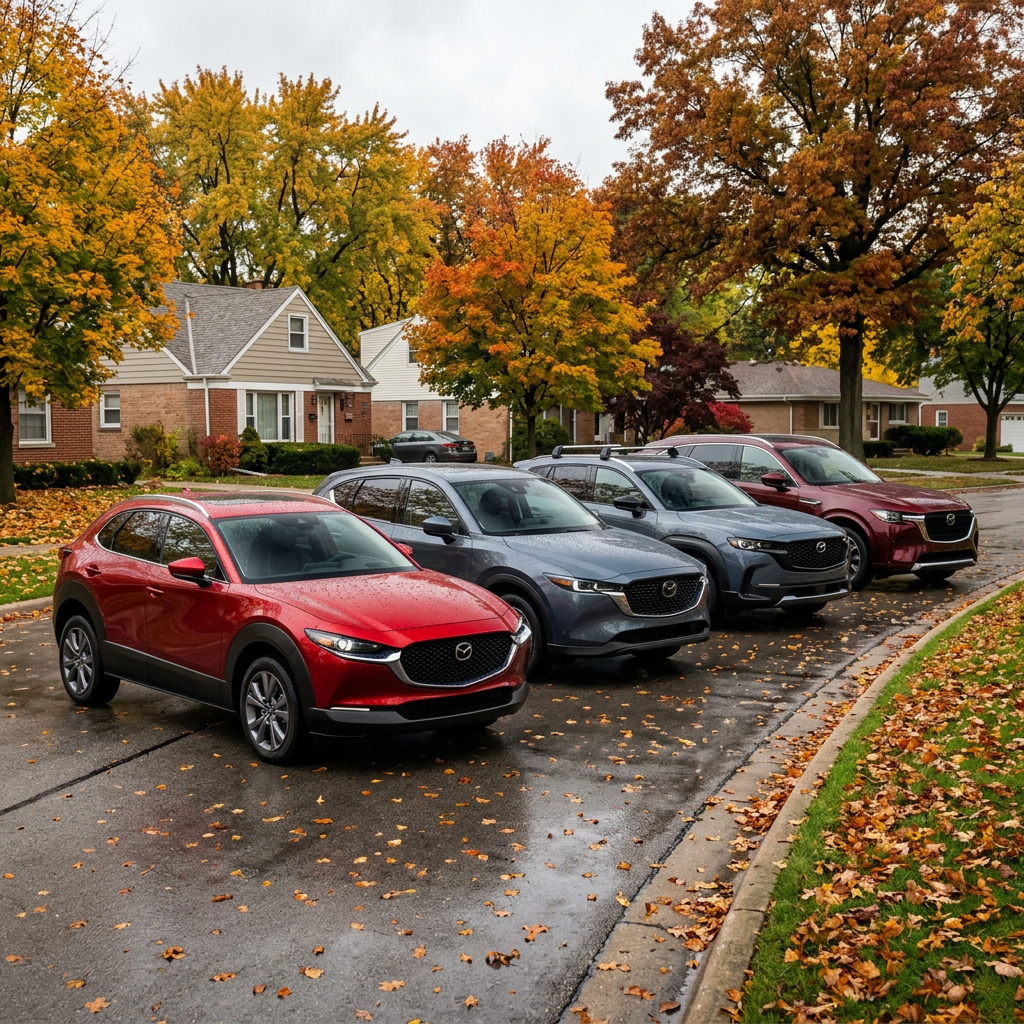
Perfect for nimble suburban maneuvering and daily commutes. Standard i-Activ AWD combined with compact footprints make parking effortless while providing stellar wet-road stability. You can Shop Certified Pre-Owned Mazda or explore new inventory.
Mazda CX-50
Built for outdoor enthusiasts heading into state parks and gravel trails. Features higher ground clearance, wider stance, and dedicated Mi-Drive Off-Road modes for handling deep mud, wet fallen leaves, and unpaved terrain.
Mazda CX-90
The flagship 3-row crossover featuring rear-biased i-Activ AWD, high towing capacity, and spacious seating for eight. Ideal for large families taking extended autumn holiday road trips across the Midwest.
|
Mazda AWD Model
|
Standard AWD
|
Ground Clearance
|
Best Autumn Application
|
|
Mazda CX-30
|
Standard i-Activ AWD
|
8.0 Inches
|
Suburban commuting & daily rain driving
|
|
Mazda CX-5
|
Standard i-Activ AWD
|
7.9 Inches
|
All-around family comfort & city safety
|
|
Mazda CX-50
|
Standard i-Activ AWD
|
8.3–8.6 Inches
|
Outdoor adventures, trailhead & leaf excursions
|
|
Mazda CX-90
|
Standard Rear-Biased AWD
|
8.0 Inches
|
3-row family road trips & heavy towing
|
Experience i-Activ AWD Traction at Hawk Mazda in Plainfield Today
Don't let slick autumn leaves or sudden rain downpours compromise your peace of mind on Northern Illinois roads. Discover the predictive power, confidence, and driving dynamics of Mazda i-Activ AWD for yourself. Visit Hawk Mazda in Plainfield, IL to test drive an autumn-ready CX-5, CX-50, or CX-90 today. You can Browse New Mazda Inventory, explore pre-owned options through our Browse Used Vehicle Inventory, or get pre-approved quickly when you Apply For Financing Now. Stop by our showroom or call our friendly team to get started!